

Climate volatility now presents an unprecedented threat to commercial agriculture. Sudden hailstorms can decimate entire orchards in mere minutes. Extreme heatwaves and shifting pest migrations further squeeze already tight crop margins. You can no longer rely purely on reactive loss management. Physical crop protection serves as a highly measurable risk-mitigation asset. It directly stabilizes yield predictability instead of acting as a sunk cost. Procurement managers and agronomists need reliable methods to secure their harvests. This guide provides a clear, evidence-based framework for evaluating these physical barriers. You will learn how to properly select and install agricultural netting based on exact environmental threats. We will cover material evaluation, structural realities, and supplier vetting. By the end, you will understand how to transform unpredictable environmental risks into highly manageable operational factors. Implementing the correct defensive infrastructure guarantees long-term farm profitability.
Key Takeaways
Aligning netting specifications (mesh size, shading rate) with exact local threats prevents over-spending and unintended microclimate issues.
The viability of an agro protection net depends heavily on verifiable UV stabilization and raw material quality (e.g., virgin HDPE).
Installation failures are rarely due to the net itself, but rather inadequate structural support for dynamic loads (wind, ice, hail accumulation).
Supplier shortlisting should prioritize technical data transparency, warranty clarity, and custom fabrication capabilities.
The Commercial Business Case for an Agro Protection Net
Farming operations face rising operational expenses every season. It becomes crucial to justify every single capital expenditure. You must compare historical harvest losses against the annualized cost of netting infrastructure. Calculate your break-even point carefully. A robust Agro Protection Net often pays for itself after just one severe weather event. Consider high-value crops like cherries or apples. A single ten-minute hail event can wipe out an entire year of revenue. When you view netting through this lens, it transforms from an expense into an insurance policy.
The shift toward climate-resilient farming accelerates globally. We must move from reactive loss management to proactive environmental control. Modern netting solutions do much more than block physical impacts. They buffer extreme temperature spikes during summer heatwaves. They retain crucial soil moisture by reducing wind speeds across the field. This proactive control creates a stable microclimate. Plants experience less physiological stress. They can focus energy entirely on robust fruit development.
Furthermore, physical barriers heavily support regenerative agriculture initiatives. They drastically reduce your reliance on chemical pesticides. This physical exclusion model helps growers meet strict chemical residue limits. Supermarkets demand cleaner produce every year. Installing physical barriers supports sustainable certifications easily. You can market your crops at a premium. Physical exclusion represents the safest path to strict regulatory compliance.
Core Solution Categories: Matching Material to Threat
You must match the material directly to your primary environmental threat. Over-engineering wastes money. Under-engineering invites catastrophic crop loss.
Anti-Hail Net Structures
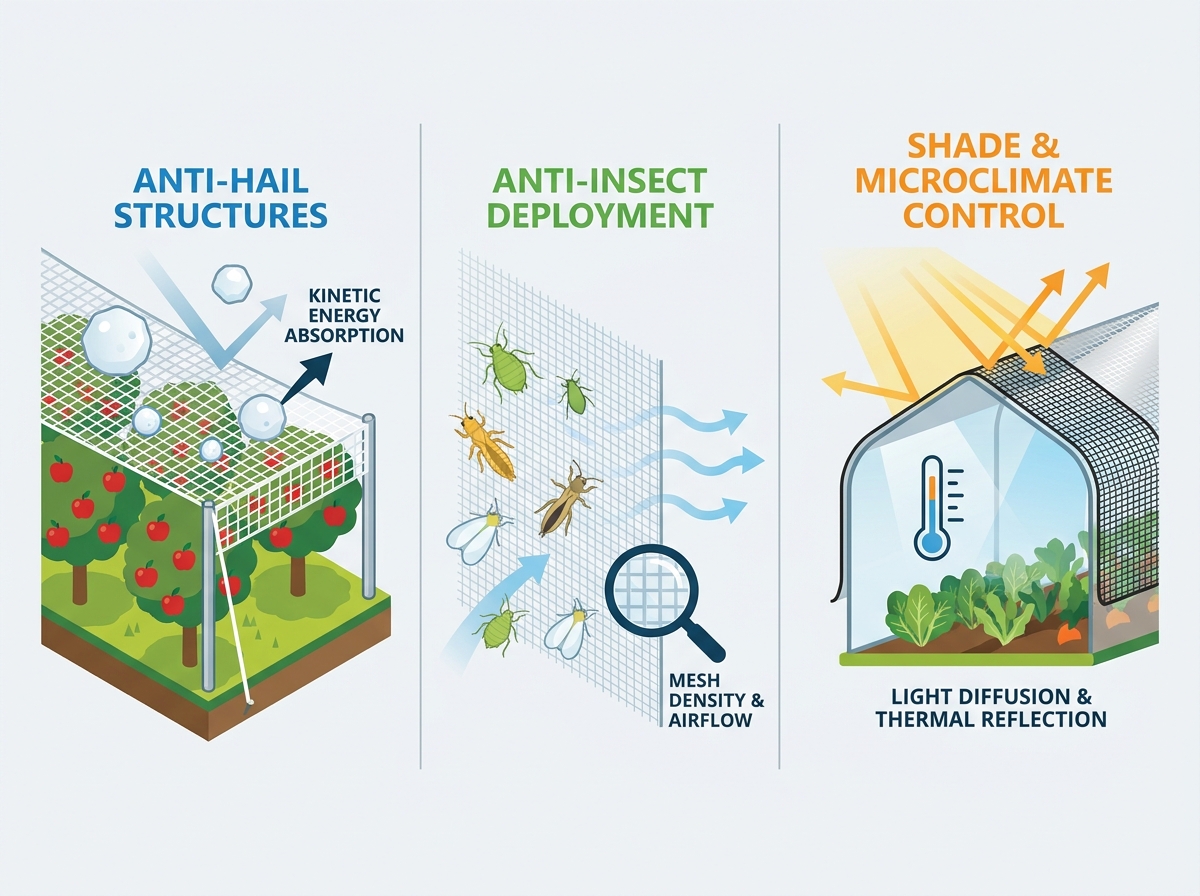
Kinetic damage to fruit stands as a massive threat. Heavy hail causes total canopy destruction in severe cases. You need a dedicated Anti-Hail Net to absorb this kinetic energy. Manufacturers generally use two weave types: Leno and Raschel. The Leno weave locks yarns firmly in place. It prevents hole expansion upon heavy impact. The Raschel weave offers high elasticity. It stretches slightly to absorb the ice's weight without tearing. You must balance structural strength against optimal light transmission. High-density meshes block more sun. This reduction in photosynthetically active radiation (PAR) can delay fruit ripening. Choose a weave protecting the canopy while feeding the plant enough light.
Anti-Insect Net Deployment
Vector-borne viral diseases ruin entire greenhouse crops rapidly. Direct pest damage from thrips, whiteflies, and aphids requires immediate intervention. Deploying a precise Anti-Insect Net solves this organically. Mesh density dictates success here. A standard 40-mesh blocks larger aphids. However, you need a tighter 50-mesh to exclude tiny thrips. Hole geometry matters just as much as yarn thickness. Square holes differ from rectangular ones in blocking efficiency. Tighter mesh excludes smaller pests effectively. Unfortunately, it restricts natural airflow significantly. This restriction potentially increases greenhouse temperatures. Humidity might rise to dangerous levels. You must balance pest exclusion against climate ventilation requirements.
Shade and Microclimate Control
Sunscald degrades fruit quality aggressively. Extreme evaporation wastes expensive irrigation water. Shade nets combat these specific threats directly. Shading percentages range widely across the industry. You might choose a light 20% shade for mild climates. Desert operations often require up to 80% shading. Color variations play a huge role in plant physiology. Black nets absorb heat heavily. They provide maximum shade but warm the air above them. White nets diffuse light deeply into the plant canopy. This diffusion improves overall photosynthesis. Aluminized nets reflect thermal energy back into the sky. They provide superior cooling during extreme summer heatwaves.
Critical Evaluation Dimensions for Procurement
Selecting the right manufacturer requires careful technical scrutiny. You cannot rely on marketing claims alone.
Material Integrity and UV Stabilization
Quality begins at the molecular level. You should insist on 100% virgin High-Density Polyethylene (HDPE). It heavily outperforms recycled plastic blends. Recycled polymers possess weakened molecular chains. They degrade rapidly under harsh solar radiation. Manufacturers must add high-quality UV inhibitor additives. These chemicals dictate multi-year field exposure survival. Without premium UV stabilization, the plastic becomes brittle within two seasons.
Features-to-Outcomes Mapping
You must correlate technical data sheet metrics directly to expected field performance. Weight per square meter indicates material density. Yarn thickness determines mechanical durability. These metrics are not arbitrary numbers.
Here is a reference chart mapping technical features to agricultural outcomes:
Technical Metric | Expected Field Outcome | Procurement Consideration |
|---|---|---|
Weight (GSM) | Determines overall durability and wind resistance capacity. | Heavier nets require stronger support poles. |
UV Additive Percentage | Prevents plastic degradation from intense solar radiation. | Crucial for regions closer to the equator. |
Yarn Thickness (mm) | Defines tear resistance during extreme weather events. | Thicker yarn reduces light transmission slightly. |
Shading Factor (%) | Controls the internal microclimate and evaporation rate. | Must match specific crop light requirements. |
Customization and Scalability
Evaluate potential suppliers on their custom fabrication capabilities. Check their maximum width availability. Wider rolls minimize the need for field seams. Seams often represent the weakest point in a structure. Look for reinforced selvedges along the edges. Reinforced edges prevent fraying under high tension. Grommet configurations must match your specific field dimensions exactly.
Quality Assurance and Certifications
Request concrete proof of ISO manufacturing standards. Ask for independent tensile strength testing results. Verify their eco-toxicity compliance. A reliable manufacturer provides these technical documents without hesitation. Never purchase bulk materials without verifying these certifications firsthand.
Implementation Realities: Installation and Structural Risk Mitigation
Even the best material fails if installed improperly. Installation failures rarely stem from the fabric itself.
Structural Load Calculations
You must assess your existing framework's capacity rigorously. Wood, steel, and concrete handle dynamic loads very differently. You have to calculate the added wind resistance carefully. Dense nets act like giant sails during heavy storms. Furthermore, factor in the immense weight of accumulated hail or snow. A net full of ice exerts massive downward pressure on poles and anchors.
Follow these structural assessment steps:
Measure the exact dimensions of your target field.
Identify the prevailing wind direction and maximum historical wind speeds.
Evaluate the depth and stability of your current perimeter anchors.
Calculate the maximum potential ice load based on local climate history.
Tensioning and Fastening Systems
Proper accessories play a critical role in system longevity. You must use specialized plastic clips. Rely on strong steel wire ropes. Bungee ties provide essential flexibility during wind events. These components prevent dangerous friction wear at the contact points. They distribute mechanical stress evenly across the entire surface. Rigid fastening causes the plastic to tear prematurely.
Rollout Logistics
Timing matters immensely during deployment. Schedule your installation carefully around crop cycles. You want to avoid disrupting sensitive pollination periods. Estimate your required labor hours per hectare accurately. Establish clear operational protocols for seasonal retraction. Retracting nets during the off-season extends their field lifespan significantly.
Hidden Costs
Budgeting requires looking past the initial purchase invoice. You must factor in ongoing seasonal maintenance. Structural upgrades often become necessary over time to support the extra weight. You might need specialized installation equipment like cherry pickers or tensioning winches. Plan for these expenses early in your budget cycle. They form a crucial part of long-term financial planning. Ignoring them leads to mid-season financial shortfalls.
Procurement Logic: How to Vet a Supplier and Next Steps
Procurement managers must adopt a rigid vetting process. Treat your netting supplier as a long-term operational partner.
Technical Transparency
Reject vendors immediately if they hide technical data. They must provide detailed technical documents upon request. Third-party testing reports show true transparency and confidence. If a supplier only talks about price, walk away. You need scientific data to make an informed decision.
Warranty Verification
Scrutinize all warranty terms carefully before signing. Understand the critical difference between pro-rated and full replacement warranties. Look for specific environmental conditions voiding your coverage. Distinguish clearly between an expected lifespan and a legally guaranteed lifespan. Many suppliers boast a ten-year lifespan but only guarantee three years.
When reviewing a warranty, look for these common pitfalls:
Lack of coverage for specific chemical exposure (like sulfur or chlorine).
Requirements for specialized winter storage.
Vague definitions of normal wear and tear.
Complex claims processes requiring excessive documentation.
Sample Testing
Always request physical samples before placing bulk orders. You need to verify yarn quality firsthand. Check the weave consistency manually by pulling it diagonally. Inspect the reinforced edges closely. A physical sample reveals manufacturing flaws easily hidden by glossy brochures.
Next-Step Action
Conduct a site-specific threat assessment today. Gather your exact topographical data. Record your local climatic patterns meticulously. Request customized quotes based strictly on these specific inputs. Demand tailored solutions rather than accepting off-the-shelf compromises.
Conclusion
Selecting the right netting requires careful, scientific balance. You must weigh exact threat specificity, material science, and structural reality. Buying an overly dense mesh hurts crop development. Buying weak yarn invites disaster during the next severe storm.
We encourage decision-makers to move beyond generic price-per-roll metrics. Focus entirely on annualized return on investment. A premium net might cost twenty percent more upfront. However, it will likely last twice as long in the field. It protects your high-value yields consistently year after year.
Audit your historical crop loss data right now. Identify your biggest environmental vulnerabilities. Contact a technical specialist to design a bespoke netting configuration tailored precisely to your farm's unique challenges.
FAQ
Q: What is the realistic field lifespan of a high-quality agro protection net?
A: A high-quality net made from 100% virgin HDPE with premium UV stabilizers typically lasts 5 to 8 years. Lifespan depends heavily on local solar radiation intensity, chemical exposure, and proper seasonal retraction. Cheaper recycled alternatives often degrade within two seasons.
Q: Can an anti-hail net also function as an anti-insect net?
A: Generally, no. Hail nets feature larger mesh sizes (e.g., 2mm to 7mm) designed specifically to absorb kinetic impact while maximizing light. This weave is far too wide to exclude small insects. You must deploy specialized, tighter insect netting for pest control.
Q: How do different netting colors affect plant growth and yield?
A: Color alters light spectrum and temperature. Black nets provide maximum shade but absorb heat. White nets diffuse light deeply into the canopy, improving photosynthesis and fruit color. Aluminized nets reflect intense infrared heat, actively cooling the microclimate below.
Q: What happens if the netting is damaged; can it be patched or repaired in the field?
A: Yes. Minor tears and punctures are easily repaired in the field. You can use specialized UV-stabilized repair tape, zip ties, or heavy-duty lacing cord. Prompt repairs prevent small rips from expanding rapidly under high wind loads.
Q: Are there standardized mesh sizes required for specific pest exclusions (like thrips)?
A: Yes. Pest exclusion requires precise hole dimensions. A 40-mesh net effectively blocks whiteflies and aphids. To exclude tiny pests like thrips, you generally need a denser 50-mesh or 60-mesh. Always match the screen geometry directly to the target pest.


