

Commercial farming profitability relies on proactive risk mitigation. Unpredictable weather events can easily wipe out seasonal margins overnight. Pests present an equally destructive threat to delicate cash crops. This reality makes selecting the right protective barrier much more than a generic purchase. It represents a strategic infrastructure upgrade for your agricultural operation. To ensure consistent crop yields, agribusinesses must align net materials and structural features directly to precise environmental threats. You cannot treat sun mitigation using the exact same parameters applied to heavy hail defense. In this guide, you will discover how to evaluate material durability and choose proper netting frameworks. We explore weave types, mesh configurations, and critical installation practices. By understanding these core elements, you can implement protective systems designed to defend crops efficiently. You will optimize overall farm productivity year after year.
Key Takeaways
High-Density Polyethylene (HDPE) with UV stabilization is the commercial standard for longevity and durability.
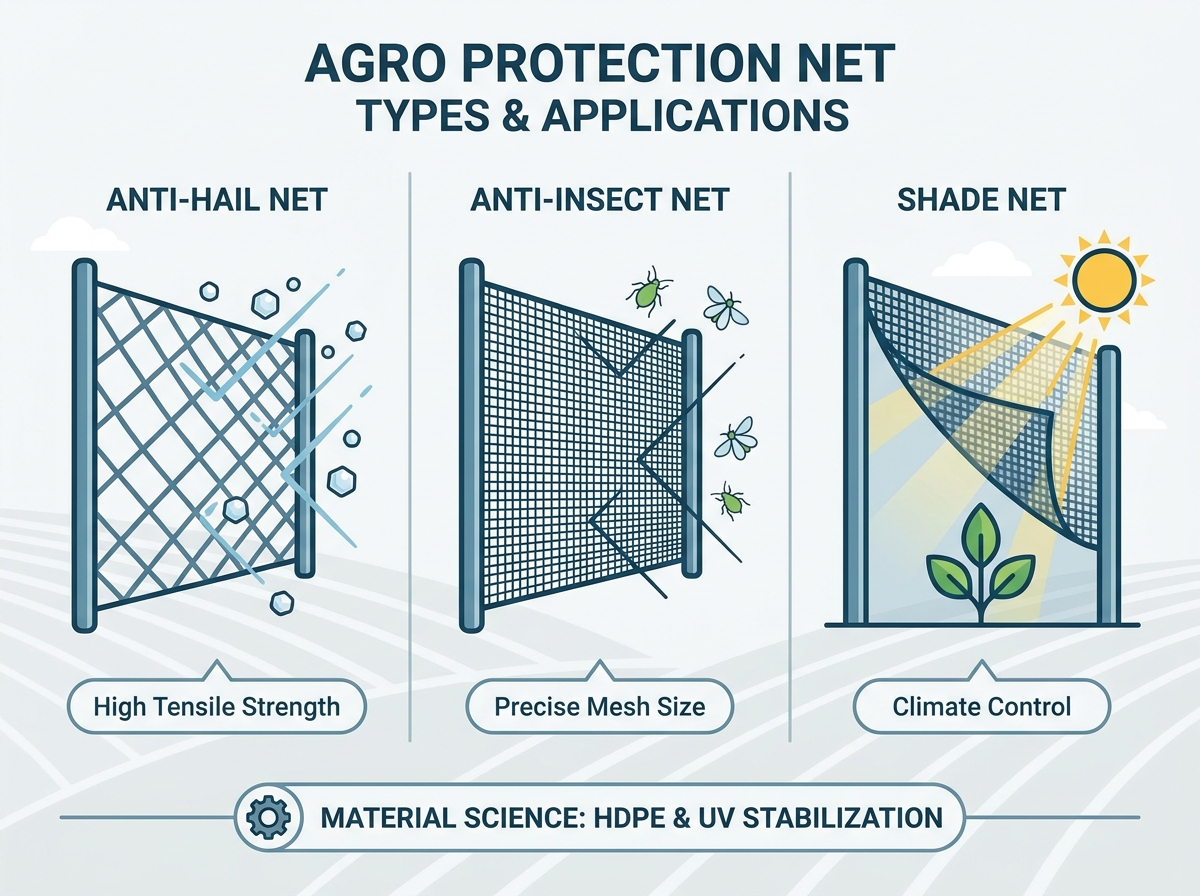
Application dictates specifications: An anti-hail net requires high tensile strength and specific mesh structures, while an anti-insect net relies on exact hole sizing to block specific vectors without suffocating crops.
Evaluating suppliers requires looking beyond unit price to assess UV warranties, reinforced edging (selvage), and documented cost-benefit outcomes.
Improper installation—specifically inadequate tensioning or poor structural support—is the leading cause of premature net failure.
The Business Case for Agro Protection Net Systems
Unprotected commercial crops face compounding daily threats. Extreme weather conditions drastically impact crop viability. High UV indexes burn sensitive foliage quickly. Sudden hail storms strip orchards bare in minutes. Migrating pest populations introduce destructive viral vectors into healthy fields. These factors combined lead directly to significant yield loss. Farmers also suffer severe quality downgrades at harvest. Supermarkets reject damaged fruits and vegetables outright. Consumers expect flawless produce. You must deliver unblemished crops consistently to maintain retail contracts.
Installing an effective Agro Protection Net system fundamentally changes this dynamic. Physical barriers stop destructive elements before they reach the plant canopy. You reduce your reliance on chemical interventions. Physical pest exclusion blocks insects naturally. This approach directly supports sustainable farming practices. Sustainable farming creates healthier soil profiles over time. It protects local groundwater from toxic agricultural runoff.
Regulatory compliance presents another major operational hurdle. Global markets demand stricter chemical residue limits on imported produce. Organic certifications require rigorous pesticide reduction plans. Physical netting aligns perfectly with these stringent export market requirements. You secure better market access. You easily maintain organic compliance protocols. Farm operations run smoother when physical defenses replace complex spray schedules.
Material Science: Evaluating Agriculture Net Durability
Material selection defines the operational success of your protective infrastructure. High-Density Polyethylene (HDPE) remains the definitive industry benchmark. HDPE offers a remarkably high strength-to-weight ratio. The material feels lightweight but resists incredible environmental stress. It naturally withstands harsh agricultural chemicals. Sprays and fertilizers do not degrade its structural integrity.
Manufacturers construct these nets using two primary yarn types. You must understand the difference between monofilament and tape yarn. Selecting the wrong yarn type compromises your entire protective strategy.
Material Weave Comparison
Yarn Type | Structural Characteristic | Primary Advantage | Best Application |
|---|---|---|---|
Monofilament | Single, solid extruded plastic strand | Superior tensile strength and airflow | Heavy-duty physical impact defense |
Tape Yarn | Flat, slit plastic sheet | Higher surface area coverage | Precise thermal shading |
Combination | Interwoven monofilament and tape | Balanced strength and coverage | Multi-purpose climate control |
Monofilament yarns feature solid plastic strands. They provide superior tensile strength and excellent airflow. Farmers prefer monofilament for heavy-duty protection against physical impacts. Tape yarn consists of flat plastic sheets. They offer higher surface area coverage. Growers utilize tape yarn primarily for precise shading applications. Some advanced nets combine both types to maximize versatility.
Untreated plastics degrade rapidly under intense sunlight. High-UV agricultural zones destroy unprotected polymers within months. North America and Australia present particularly harsh solar environments. Manufacturers must incorporate verifiable UV-resistant additives during extrusion. These stabilizers absorb harmful ultraviolet radiation. They prevent the plastic polymer chains from breaking down. You should always demand verifiable UV stabilization formulas. This critical step guarantees a functional lifespan exceeding five years. Skipping UV protection causes the plastic to turn brittle and shatter.
Categorizing Nets by Application and Threat-Level
Every environmental threat demands a specialized netting solution. General-purpose nets rarely deliver optimal results. You must match the net specifications directly to your local risks. Analyzing your primary environmental stressor helps you narrow down the correct product category.
Anti-Hail Net Solutions
Heavy hail can devastate an entire season of work in minutes. A dedicated Anti-Hail Net must absorb high-velocity impacts repeatedly. The material cannot tear under sudden stress. The net must also protect the underlying support structure from collapsing under the weight of accumulated ice.
Manufacturers utilize specific Leno or Raschel weave patterns here. These specialized weaves prevent unraveling if a sharp ice shard punctures the material. The hole remains localized. It does not run across the entire span. Reinforced margins ensure secure anchoring to the framework. These nets also offer valuable secondary benefits. They provide mild shading for the crop canopy. They act as highly effective windbreaks during severe storms.
Common Mistake: Do not install hail nets completely flat. Flat installations trap ice. The accumulated weight will crush the framework. You must angle the structure to allow ice to slide off harmlessly.
Anti-Insect Net Solutions
Pest management requires precision. An effective Anti-Insect Net blocks specific vectors successfully. Farmers use them to exclude thrips, aphids, and whiteflies. However, the net must simultaneously maintain necessary microclimate ventilation. Suffocating the crop is a genuine risk.
Industry standards measure these nets in "mesh size" or holes per inch. Higher mesh density creates smaller holes. Smaller holes block tinier insects effectively. Yet, high-density meshes restrict natural airflow significantly. You must manage internal humidity carefully when using dense meshes. Poor ventilation leads directly to fungal diseases in enclosed environments.
Best Practice: Always identify your smallest target pest first. A 40-mesh net blocks whiteflies perfectly. However, you need a tighter 50-mesh net to stop smaller thrips. Choose the exact mesh size required to balance exclusion and ventilation.
Shade Nets & Climate Control
Heat stress damages crops severely. Shade nets regulate photosynthesis rates and prevent direct sunburn on sensitive plants. They diffuse harsh sunlight into usable light.
Suppliers grade these products by their specific shading rate. Rates typically range from 30% to 90%. You choose the rate based on crop tolerance. Orchids require heavy shade. Tomatoes need much lighter coverage. Aluminum-coated nets, commonly known as Aluminet, offer advanced thermal reflection. They bounce solar radiation away during the day. They trap thermal heat inside during cool nights. You find Aluminet in both agricultural and industrial dual-use scenarios.
Netting Specifications Chart
Net Category | Primary Function | Key Measurement Metric | Typical Lifespan |
|---|---|---|---|
Anti-Hail | Impact absorption | Tensile Strength & GSM | 5–8 Years |
Anti-Insect | Pest exclusion | Mesh Size (Holes/Inch) | 3–5 Years |
Shade Cloth | Thermal regulation | Shading Percentage (%) | 4–7 Years |
Procurement Framework: Key Features to Evaluate
Evaluating suppliers requires a systematic approach. You must scrutinize specific technical features before finalizing any bulk order. Visual inspections alone cannot confirm structural integrity.
Assess Tensile Strength and Weight: Grams per square meter (GSM) indicates overall material durability. Higher GSM generally means thicker, stronger netting. However, you must balance GSM against the load-bearing capacity of your farm framework. Heavy nets cause weak poles to snap under wind pressure. Always verify the fabric weight matches your structural limits.
Demand Edge Reinforcement: Raw net edges tear easily under moderate wind loads. Manufacturers call the reinforced edge a selvage. Unreinforced edges rip at their connection points constantly. You should specifically demand double-reinforced selvages for high-stress installations. This reinforcement anchors the entire system safely.
Evaluate Customization Capabilities: Seaming pieces together on-site wastes valuable labor hours. Ask suppliers about providing custom widths to match your specific row spacing. Pre-installed grommets and buttonholes speed up installation dramatically. They ensure uniform tension across the entire span. Customization eliminates dangerous weak points created by manual sewing in the field.
Verify Warranty Transparency: Many suppliers offer vague lifespan estimates. A lifespan estimate holds no legal weight. You need a legally binding warranty specifically covering UV degradation. This document protects your infrastructure investment long-term. Read the fine print to understand pro-rated replacement terms.
Implementation Risks and Installation Realities
Even the highest-quality net fails if installed improperly. Installation errors cause the vast majority of structural collapses. You must plan the physical deployment as carefully as the material selection.
Structural Load Bearing Constraints
Nets accumulate significant weight quickly. Snow, heavy hail, and trapped organic debris add massive downward pressure. Your underlying pole-and-wire infrastructure must handle maximum environmental loads. Engineers must calculate the combined weight of the net, trapped ice, and extreme wind forces. Do not design frameworks based solely on the dry weight of the fabric. Timber poles must feature deep concrete footings. Galvanized steel frames offer superior rigidity.
Hardware and Tensioning Failures
Farmers often attempt to save money on installation accessories. Using cheap plastic clips instead of UV-treated hardware leads directly to sagging. Sagging creates dangerous friction points across the support wires. The wind rubs the fabric against the wire continuously. This friction accelerates wear and tears the net apart prematurely. Always use professional-grade tensioning ratchets. Maintain taut lines across every square meter.
Maintenance Protocol Best Practices
Regular Seam Inspection: Walk your rows monthly to check high-stress connection points. Look for stretched grommets or fraying threads.
Prompt Patching: Repair small, localized tears immediately before wind expands them. Use dedicated UV-resistant lacing cord.
Proper Storage: Retractable nets require careful handling during the off-season. Clean the nets thoroughly and store them in dry, dark environments away from rodents.
Next Steps: Shortlisting Vendors and Planning Rollout
Transitioning to protective infrastructure requires careful vendor selection. You should approach the buying process methodically. Rushing this phase leads to expensive structural replacements later.
Never make purchasing decisions based purely on marketing brochures. You must request detailed Technical Data Sheets (TDS). Ask suppliers for independent, lab-tested specifications. Focus specifically on tensile strength ratings and verified UV resistance percentages. Legitimate manufacturers share these documents willingly. They prove the true capability of the extruded polymers.
Always request physical product samples. Holding the material reveals crucial details. You can inspect the weave quality directly. You can measure the selvage thickness yourself. Evaluating material flexibility helps you anticipate installation challenges. Stiff, brittle samples indicate poor manufacturing controls.
Large-scale agribusinesses should execute pilot testing first. Consider installing the net over a single-acre test plot. Monitor the internal microclimate changes closely for an entire season. Observe the structural stability during your region's worst weather months. Check humidity levels under dense meshes. Track the exact impact on crop yields. This pilot data informs your final, full-farm rollout strategy perfectly. It removes the guesswork from massive infrastructure upgrades.
Conclusion
Investing in a robust protective netting system transforms your entire agricultural operation. You shift farm management away from reactive disaster recovery. You move directly toward proactive yield optimization. Weather anomalies and pest swarms no longer dictate your harvest success.
Always prioritize premium material quality. Demand HDPE integrated with high-grade UV stabilizers. Match exact product specifications like mesh size and shading rate directly to your regional climate. Ensure the net perfectly suits your specific crop type. Do not compromise on edge reinforcements or installation hardware.
Take time today to assess your primary crop threats accurately. Identify your most vulnerable acreage. Reach out to qualified manufacturers for custom technical consultations. By implementing the right physical barriers, you secure your harvest and protect your agricultural future.
FAQ
Q: What is the average lifespan of an HDPE agro protection net?
A: A high-quality HDPE net typically lasts between 5 and 8 years. The exact lifespan depends heavily on your regional UV index and maintenance routines. Consistent upkeep and proper tensioning extend operational viability significantly.
Q: Can one net serve as both an anti-hail net and an anti-insect net?
A: Using a single net for both purposes involves major trade-offs. Fine meshes block insects but catch dangerous amounts of wind and hail weight. Traditional hail nets feature holes too large to stop tiny pests. Dual-purpose applications require highly specialized engineering to prevent structural collapse.
Q: How does mesh size affect airflow and temperature inside a greenhouse or hoop house?
A: Mesh density and ventilation share an inverse relationship. Higher mesh densities block more insects but restrict natural airflow dramatically. This restriction traps thermal heat inside. It also increases humidity levels rapidly, which elevates the risk of fungal diseases.
Q: What is the best way to repair a small tear in agricultural netting?
A: You must repair small tears immediately to prevent run-out. Use commercial UV-resistant zip ties or specialized lacing cords for quick fixes. Many manufacturers also provide dedicated patching kits designed to blend securely with the original weave pattern.


