

Climate volatility constantly threatens agricultural stability today. Evolving pest pressures turn predictable crop yields into high-risk variables quickly. Heavy storms can decimate months of careful cultivation in minutes. Unexpected hail destroys delicate fruit canopies. Invasive insects introduce devastating viral pathogens. Reactive chemical treatments no longer provide sustainable defense mechanisms. They face strict regulatory bans and reduced biological efficacy. Consequently, forward-thinking agribusinesses now shift toward proactive physical barriers. They use these structural systems to secure their vulnerable harvests. This guide provides a clear framework for evaluating protective infrastructure. You will learn how to select the right agro protection net for your unique operational needs. We help you secure profit margins and significantly reduce seasonal crop loss. We explore exact material specifications and structural demands in detail. Procurement managers can use these practical insights confidently. You will make informed, resilient infrastructure investments.
Key Takeaways
Outcome-Driven Protection: The core value of an agro protection net lies in minimizing quantifiable yield loss from specific threats (weather, pests) rather than generic coverage.
Specification Matching: Success requires matching mesh sizes, weave types, and material durability to regional threats (e.g., deploying an anti-hail net for physical impact vs. an anti-insect net for pathogen control).
Supplier Vetting: Reliable procurement relies on verifiable material certifications (like high-density polyethylene/HDPE quality) and transparent warranty terms.
The Commercial Case: Framing the Business Problem
Unpredictable weather directly threatens your commercial bottom line. Sudden hailstorms cause immediate mechanical damage to delicate crops. Severe winds snap young stems and bruise developing fruits. You lose marketable produce instantly when physical impacts occur. Yield predictability vanishes when you leave fields entirely exposed. Climate risks fluctuate wildly from season to season. An effective barrier transforms this environmental uncertainty into a manageable risk. You stabilize your expected harvest volumes effectively.
Beyond extreme weather, you face constantly escalating input costs. Pesticides and herbicides drain operational budgets year after year. Implementing physical barriers dramatically reduces your reliance on chemicals. They block adult pests from reaching the crop canopy entirely. This proactive exclusion lowers ongoing chemical expenses significantly. It also supports strict organic farming compliance requirements. You can market cleaner produce to premium buyers. You spend less money on recurring chemical applications.
Protective netting also provides secondary returns through microclimate optimization. These woven structures do much more than block hazards. They control internal light diffusion and manage ambient temperatures. They also improve vital soil moisture retention during droughts. Diffused light prevents localized sunburn on upper plant leaves. Retained moisture accelerates growth cycles and reduces daily irrigation demands. You essentially create an optimized growing environment. You tailor this microclimate to your specific commercial crop.
Solution Categories: Matching the Net to the Threat
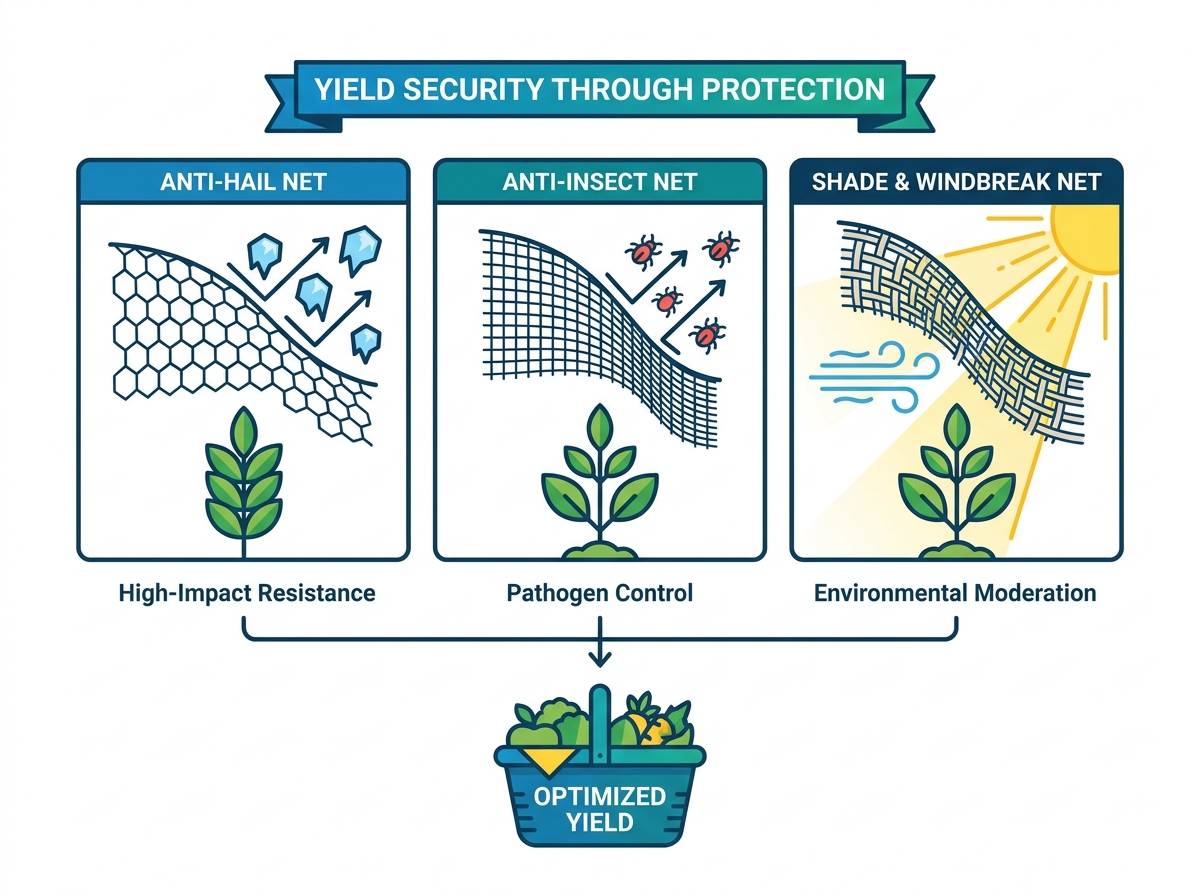
You must evaluate weave patterns carefully for impact resistance. Manufacturers generally use Leno or Raschel weaves for an anti-hail net. A Leno weave offers superior rigidity and locking strength. It bears sudden heavy ice loads without tearing apart. Raschel weaves provide more flexibility and elasticity. They stretch under sudden pressure and bounce back smoothly. You need high tensile strength to prevent complete structural collapse. The right weave keeps heavy hail suspended above your crops safely. It protects the fragile blossoms and fruits below.
Pest exclusion requires highly precise mesh size calibration. You deploy an anti-insect net to control disease vectors actively. Common pests include thrips, aphids, and whiteflies. Standard commercial options range from 40-mesh to 50-mesh configurations. You must balance pest exclusion against necessary internal airflow. If you choose an overly dense mesh, internal humidity spikes dangerously. High humidity encourages devastating fungal diseases rapidly. Choose a configuration blocking your specific target pathogen reliably. It must still maintain optimal ventilation for plant respiration.
Excessive sunlight and strong winds cause severe mechanical stress. Shade nets moderate the growing environment by reducing solar intensity. You can select shading percentages ranging from 20% to 90%. Tailor this specific percentage to your crop photoperiod needs. Windbreak nets prevent wind-induced damage like stem breakage. They disrupt chaotic wind currents smoothly. They protect the delicate plant structures positioned behind them.
Netting Application Matrix
Threat Type | Recommended Solution | Key Technical Feature | Primary Benefit |
|---|---|---|---|
Heavy Ice / Hail | Anti-Hail Net | Leno or Raschel Weave | Prevents mechanical fruit damage |
Thrips / Whiteflies | Anti-Insect Net | 40 to 50-Mesh Calibration | Blocks viral pathogen vectors |
Solar Scorch | Shade Netting | 20% - 90% Light Diffusion | Prevents leaf surface sunburn |
High Wind Velocity | Windbreak Net | High Tensile Monofilament | Reduces stem mechanical stress |
Core Evaluation Dimensions: From Features to Outcomes
High-quality plastics form the absolute foundation of reliable nets. You should always assess the baseline raw material carefully. Demand 100% virgin high-density polyethylene (HDPE) for maximum durability. Recycled plastics often contain microscopic weaknesses and impurities. You must also verify the inclusion of premium UV stabilizers. Premium chemical additives prevent early photodegradation effectively. Sun-drenched agricultural regions destroy untreated plastics in one season. Proper chemical stabilization ensures your infrastructure survives intense solar exposure.
Look closely at the specific net construction details. Reinforced selvages along the edges are absolutely critical. They prevent tearing at high-stress structural attachment points. When winds whip across the field, edges bear maximum loads. Evaluate monofilament versus tape yarn constructions during procurement. Monofilament threads offer superior tear resistance and dimensional stability. Tape yarns might cost slightly less initially. However, they often fray under constant environmental friction. You want robust construction withstanding daily physical abrasion.
Agricultural plastics face growing regulatory scrutiny globally today. You must address these strict environmental requirements proactively. Evaluate the end-of-life recyclability of your chosen materials. Nets manufactured from pure uncontaminated HDPE remain fully recyclable. Ask your supplier about their eco-friendly manufacturing processes. Sustainable procurement improves your corporate ESG compliance profile. It prevents thousands of tons of plastic from entering landfills.
Best Practices for Material Evaluation
Request raw material certificates confirming pure virgin HDPE usage.
Inspect physical samples for reinforced selvage thickness before ordering.
Verify chemical UV stabilizer concentrations matching your regional solar index.
Demand independent laboratory tests confirming exact tensile strength limits.
Implementation Realities: Infrastructure and Rollout Risks
Installing heavy-duty nets on inadequate frames introduces massive risks. You cannot ignore support structure compatibility during planning. Structural engineering must account for dynamic environmental loads accurately. Hail netting traps thousands of pounds of ice suddenly. Severe winds push against insect mesh like solid sails. If your poles lack sufficient gauge, systems collapse entirely. A collapsed structure destroys the exact crop it protects.
Large-scale deployment requires significant logistical planning and coordination. Factor in the operational downtime during the actual installation. You will need specialized equipment like elevated work platforms. Tensioning winches help achieve the correct structural tautness. Labor expenses escalate quickly if your team lacks experience. Plan your rollout during off-season windows to minimize disruption. Efficient installation relies heavily on pre-measured custom rolls. Clear deployment protocols keep your field teams safe.
You must establish realistic baseline expectations for material longevity. Determine whether you need seasonal deployment or year-round installations. Seasonal nets generally last longer overall. They avoid harsh winter conditions while packed in storage. Year-round nets face continuous UV and wind exposure daily. Implement strict protocols for inspecting anchor points monthly. You must repair minor tears immediately before winds expand them. Regular proactive maintenance extends functional lifespan significantly.
Common Mistakes During Implementation
Ignoring maximum load capacities of existing wooden support poles.
Deploying excessive mesh densities choking internal crop ventilation.
Failing to patch millimeter-sized snags before high-wind events.
Storing seasonal nets in damp environments encouraging mold degradation.
Shortlisting Logic: A Framework for Supplier Vetting
Do not trust glossy marketing brochures blindly during procurement. You must demand independent lab testing results immediately. Ask suppliers for ISO certifications regarding tensile strength. Request certified data proving long-term UV resistance capabilities. Authentic performance data reveals material behavior under extreme stress. Marketing claims often exaggerate lifespan without defining testing conditions. Verify these crucial metrics through third-party agronomic institutes always.
Reject suppliers who only offer generic one-size-fits-all solutions. Your specific fields have unique dimensions and pest threats. Ensure the manufacturer provides custom widths upon request. Custom sizing reduces the total number of structural seams. Seams always represent the weakest point in canopy architecture. A capable supplier customizes shading percentages and mesh configurations readily. They adapt their manufacturing to fit your exact requirements.
Scrutinize all prorated warranty documents carefully before signing. You must clarify exactly what constitutes normal material degradation. Does the warranty cover severe color fading over time? Does it only trigger upon complete structural material failure? Distinguish between expected environmental wear and genuine manufacturing defects. Transparent warranty terms protect your operational budget long-term. Demand clear written procedures for filing any replacement claims.
Conclusion
An agro protection net is never just a commodity purchase. It represents a critical infrastructure investment for proactive risk mitigation. You protect your entire seasonal revenue by blocking uncontrollable variables. Successful adoption always depends on aligning the specific threat accurately. You must match local hazards with precise material specifications. You cannot deploy basic shade cloth to stop heavy hail. Match the exact hazard to the correct weave and mesh.
We highly recommend procurement teams take immediate, practical action. Request physical product samples from multiple manufacturers for comparison. Review localized case studies to observe real-world climate performance. Consult with professional structural engineers to verify frame load capacities. Taking these deliberate steps ensures your protective netting performs reliably. You will achieve maximum yield security and long-term operational success.
FAQ
Q: What is the verifiable lifespan of a commercial agro protection net?
A: They typically last 3 to 8 years in the field. This lifespan depends heavily on your regional UV index exposure. It also depends on continuous versus seasonal usage. The specific quality of UV stabilizers used during manufacturing dictates longevity. High-quality additives prevent the plastic from becoming brittle prematurely.
Q: How do I choose the correct mesh size for an anti-insect net?
A: Mesh size must be dictated by the smallest target pest. For example, a 50-mesh configuration effectively blocks tiny whiteflies. However, you must avoid using an overly dense mesh if it is unnecessary. Overly tight meshes dangerously restrict internal field ventilation and cause harmful humidity spikes.
Q: Will an anti-hail net restrict sunlight enough to impact crop yield?
A: Transparent or lightly colored hail nets diffuse light rather than block it completely. This gentle diffusion can actually prevent localized sunburn on delicate plant leaves. They still allow adequate Photosynthetically Active Radiation (PAR) to reach the plants. This ensures your crops maintain steady, healthy growth cycles.
Q: Are agricultural nets recyclable?
A: Yes, they are highly recyclable if made from 100% virgin HDPE. Cross-contamination with non-HDPE threads or metal installation clips complicates the recycling process significantly. You must prioritize supplier material transparency. This ensures your obsolete nets meet strict end-of-life environmental sustainability standards properly.


