

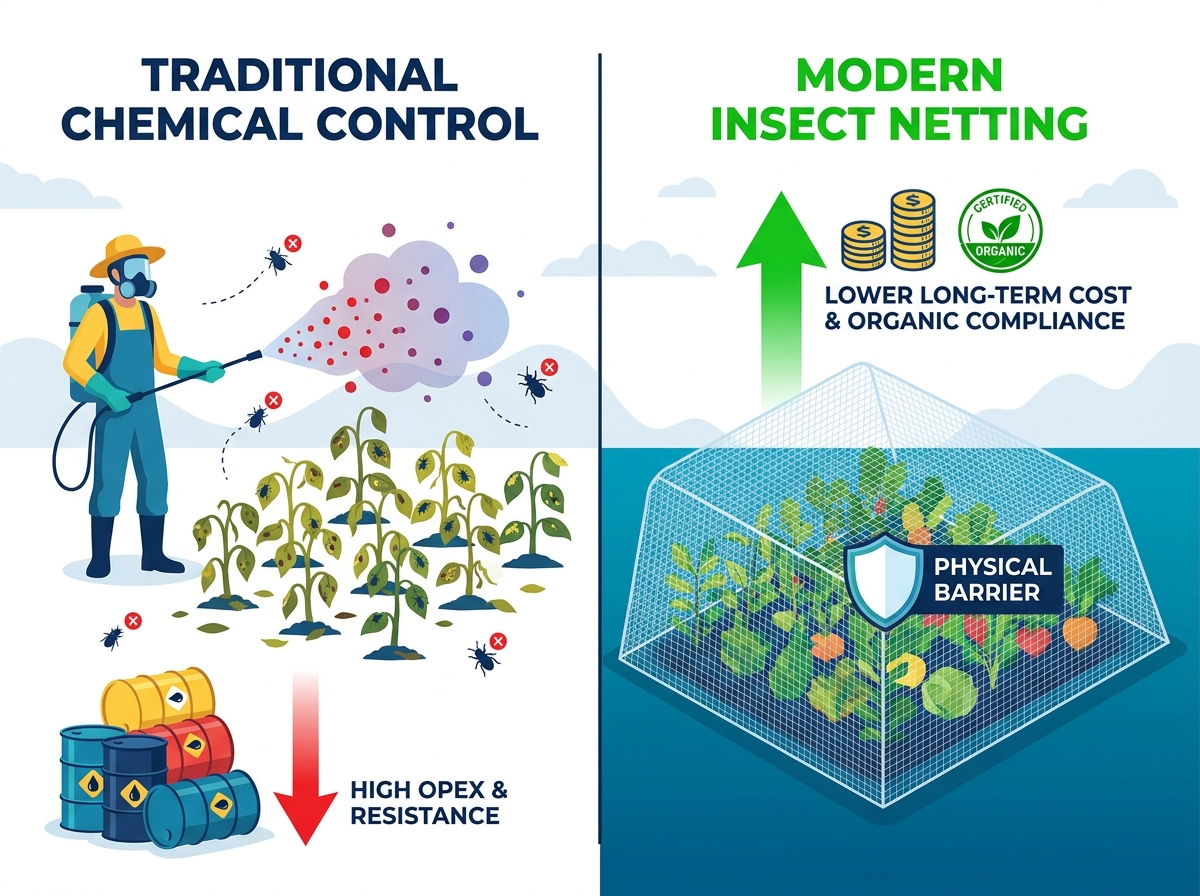
Commercial agriculture faces a critical turning point today. Traditional pest control relies heavily on ongoing chemical expenses. We must shift this narrative toward physical exclusion. Upfront infrastructure investments offer a far more sustainable path. Pesticide resistance continues rising rapidly across major farming regions. Stricter chemical residue compliance severely limits your market options. We need better solutions.
You can solve these challenges by transitioning to physical agro-barriers. They stand as a proven strategy for securing reliable yield predictability. They help you achieve strict organic compliance effortlessly. You also mitigate devastating viral diseases transmitted by tiny insect vectors. Our primary objective here is clear.
We provide commercial growers, agronomists, and farm managers a transparent framework. You will learn how to evaluate, specify, and invest wisely. You will choose the correct netting infrastructure for your specific crops. This guide empowers you to build a resilient, profitable, and future-proof farming operation.
Key Takeaways
Economic Shift: Transitioning to physical pest exclusion reduces reliance on agrochemicals, lowering recurring operational costs and opening access to premium (organic/zero-residue) markets.
Specification Dictates Success: Effectiveness hinges on matching mesh size to the specific target pest (e.g., thrips require different density than fruit flies) without critically compromising airflow.
Microclimate Impact: An Anti-Insect Net does more than block pests; it alters humidity, light transmission, and temperature—variables that must be managed to prevent secondary fungal risks.
Longevity & ROI: High-quality, UV-stabilized nets offer a 3- to 5-year operational lifespan, delivering measurable ROI when factored against chemical savings and higher marketable crop percentages.
The Commercial Business Case: Beyond Basic Crop Protection
Agrochemical costs keep rising year after year. Farm managers face shrinking margins. Vector-borne crop viruses spread faster in warmer climates. Supermarket contracts now demand stricter maximum residue limits. These limits restrict how often you can spray. They dictate exactly which chemicals you can apply. You need a reliable alternative.
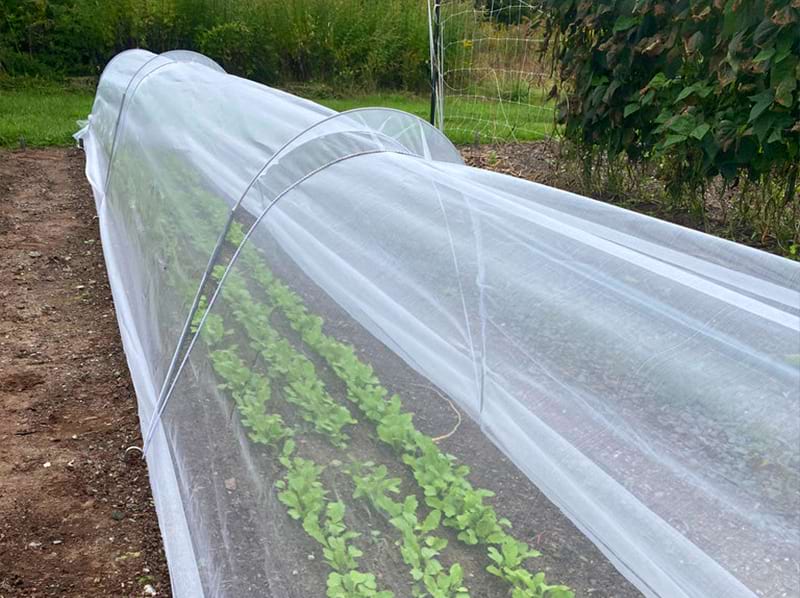
Physical exclusion barriers provide a robust answer. They act as a permanent shield over your fields. You no longer rely solely on reactive spraying schedules. A proactive barrier stops pests before they reach your plants. This fundamental shift transforms crop management entirely.
Defining Clear Success Criteria
How do we measure success when deploying physical netting? You should track three critical performance indicators across your growing season.
Measurable viral reduction: Pests like whiteflies transmit Tomato Yellow Leaf Curl Virus. Proper netting blocks these vectors. You will see a drastic drop in viral infection rates.
Decreased labor and inputs: You spray less frequently. Pesticide costs plummet. Labor hours dedicated to chemical application decrease significantly.
Increased marketable yields: Cosmetic pest damage ruins produce value. Undamaged crops achieve Grade-A status. You sell more volume at premium prices.
The Compliance Advantage
Export markets enforce rigorous safety standards. Supermarkets reject shipments showing trace chemical residues. Physical netting satisfies these stringent export regulations effortlessly. It forms the backbone of successful organic certification programs. You achieve full compliance. Yields remain consistently high. You unlock access to lucrative, health-conscious consumer markets.
Evaluation Criteria: Selecting the Right Anti-Insect Net Specification
Choosing proper netting requires careful calculation. You cannot guess the correct density. You must engineer the solution based on your exact pest pressures. If you choose incorrectly, you risk crop failure.
Mesh Size to Pest Correlation
The math of physical exclusion is critical. Mesh size defines the number of holes per linear inch. Higher numbers mean smaller holes. Smaller holes restrict airflow heavily. You must balance exclusion against ventilation.
Mesh Density | Target Pests Excluded | Airflow Impact | Best Application |
|---|---|---|---|
17–25 Mesh | Fruit flies, birds, larger moths, beetles | High airflow (Minimal restriction) | Orchards, robust field crops |
40–50 Mesh | Aphids, whiteflies, leafminers | Moderate airflow (Requires monitoring) | Vegetables, greenhouse vents |
50+ Mesh | Thrips, tiny vectors | Low airflow (Significant restriction) | High-value nursery crops, sensitive seedlings |
Always specify an Anti-Insect Net based on the smallest pest causing economic damage. Do not use 50-mesh if your only problem is fruit flies. You will suffocate your crop needlessly.
Material and Manufacturing Standards
Material quality dictates structural integrity. Commercial farming demands high tensile strength. Manufacturers use High-Density Polyethylene (HDPE) for this reason. HDPE resists tearing during heavy winds. It withstands mechanical stress during installation.
You must understand yarn structures. Monofilament yarns are single, solid strands. They offer superior strength and longevity. Tape yarns are flat strips. They cost less but degrade faster. We strongly recommend monofilament structures for permanent commercial installations. They simply last longer in harsh conditions.
UV Stabilization Rating
Baseline plastics fail quickly in commercial farming. Sunlight degrades unprotected polymers rapidly. The plastic becomes brittle. It shatters under wind tension. Pests easily breach the compromised barrier.
You must verify UV-resistance guarantees. Manufacturers add chemical stabilizers during extrusion. These additives protect the polymer chains from ultraviolet damage. Evaluate 3-year versus 5-year lifespans carefully. Demand written warranties from your supplier. A net failing in year two destroys your entire investment strategy.
Microclimate Management: Weighing the Environmental Trade-offs
Netting creates a distinct microclimate underneath the canopy. You alter the natural growing environment significantly. You must manage these newly introduced variables. Ignoring them leads to secondary agricultural disasters.
Airflow vs. Exclusion
This is your primary compromise. Finer nets block smaller insects perfectly. They simultaneously reduce wind passage drastically. Reduced airflow traps heat. It creates stagnant air pockets around plant leaves.
Evaluate your ventilation needs carefully. Greenhouse structures utilize passive roof vents. You might need active exhaust fans if you install 50-mesh screens. Hoop houses require roll-up sides. Open-field draping relies entirely on natural breezes. Always orient your structures to capture prevailing winds. This simple step maximizes passive ventilation through dense meshes.
Light Transmission Dynamics
Plants need specific light spectrums for photosynthesis. An Agro Protection Net diffuses incoming sunlight. It scatters the beams evenly across the crop canopy.
Assess the slight reduction in PAR (Photosynthetically Active Radiation). Most nets reduce light by 10 to 20 percent. This reduction sounds detrimental initially. However, diffused light often prevents severe heat stress. It eliminates leaf sunburn entirely. Your plants actually synthesize food more efficiently under harsh summer conditions. The net acts as a protective shade screen during peak solar hours.
Humidity and Disease Risk
Trapped humidity presents a severe implementation reality. Stagnant air holds moisture longer. Wet leaves invite fungal pathogens rapidly. Botrytis and powdery mildew thrive in these exact conditions. You must acknowledge this risk upfront.
Outline strict mitigation strategies. We recommend several proven approaches to manage excess humidity safely:
Alter irrigation timing: Water your crops early in the morning. This allows the soil surface to dry before evening.
Implement drip irrigation: Keep foliage entirely dry. Apply water directly to the root zone.
Adjust planting density: Space your plants further apart. Wider spacing encourages internal airflow between stems.
Revise fungicide programs: Shift from contact fungicides to systemic options if humidity remains stubbornly high.
Implementation Realities, Risks, and Shortlisting Vendors
Purchasing the netting represents only the first step. Proper installation determines ultimate success. Poor execution ruins the finest materials. You must address structural limitations before buying anything.
Structural Compatibility
Assess your existing infrastructure rigorously. High tunnels, greenhouses, and open-field frameworks bear specific load limits. High-density netting adds significant weight. It also increases wind resistance dramatically.
A 50-mesh screen acts almost like a solid sail during storms. Can your steel hoops withstand the added drag? You might need thicker gauge steel. You may need closer hoop spacing. Evaluate your anchors. Weak ground anchors will fail under peak wind loads. Reinforce your structures proactively.
Installation Best Practices
Careless installation creates vulnerabilities. You must follow strict protocols. Avoid tension tears during deployment. Never drag the fabric across sharp metal edges. Pad all structural corners securely.
Ensure perfect ground seals. Bury the bottom edges deep in the soil. Pests crawl underneath loose borders easily. Manage your entry and exit points carefully. Install double-door vestibule systems. A single door allows pests inside every time a worker enters. A double-door airlock prevents this entirely. Your barrier is only as strong as its weakest seam.
Vendor Shortlisting Logic
The agricultural plastics market contains many unreliable suppliers. You must navigate procurement carefully. Watch out for obvious red flags when shortlisting vendors.
Lack of technical data sheets: Reputable companies provide exact specifications. Avoid vendors selling generic "bug screens."
Vague UV warranties: A promise is not a warranty. Demand specific lifespan guarantees based on your geographic solar radiation levels.
Inconsistent hole geometry: Examine physical samples. Irregular holes allow targeted pests to squeeze through. Precision weaving is non-negotiable.
Next Steps for Procurement
Advise your purchasing team clearly. Request comprehensive technical specification sheets first. Demand physical samples for manual tensile testing. Pull the fabric hard. Does the weave distort? If it stretches permanently, reject it.
Ask vendors for relevant case studies. You want examples from your specific climate zone. A net performing well in cold regions might fail quickly in tropical heat. Verify their track record. Speak to other farmers using their products. Real-world durability matters more than laboratory claims.
Conclusion
An anti-insect net is never a one-size-fits-all commodity. It functions as an engineered structural barrier. It demands precise specification and rigorous installation protocols. Treating it as a simple plastic sheet leads to inevitable crop loss.
When you match the mesh correctly to your pest pressure, magic happens. You stabilize your yields predictably. You navigate local climate challenges effectively. You ensure total market compliance for export and organic sectors. The upfront infrastructure investment pays dividends quickly.
Assess your primary pest pressures today. Calculate your current annual chemical spend. Consult technical netting specialists immediately. Map out a custom structural exclusion plan tailored for your farm. Take control of your crop protection strategy now.
FAQ
Q: Does an Anti-Insect Net reduce light transmission to the plants?
A: Yes, typically by 10% to 20% depending on the mesh density and material. However, the diffused light often prevents sunburn and improves overall photosynthesis efficiency in high-heat environments. Plants generally thrive under this slightly modified light spectrum.
Q: How long does a commercial Agro Protection Net last?
A: High-quality, UV-stabilized HDPE nets generally last between 3 to 5 years under continuous field exposure. Actual lifespan depends heavily on local solar radiation intensity and physical handling. Proper winter storage can extend this lifespan significantly.
Q: Can bees and pollinators still access the crops?
A: No. Nets designed to exclude pests will also exclude natural pollinators. For pollinator-dependent crops, farmers must introduce bumblebee hives inside the netted area. Alternatively, you can manage netting timing carefully around specific blooming cycles.
Q: How do I choose the correct mesh size?
A: Identify the smallest insect causing economic damage to your crop. Use 50-mesh for thrips, 40-mesh for whiteflies or aphids, and 25-mesh for larger flies and beetles. Always choose the largest hole possible that still excludes your target pest to maximize airflow.