

Unpredictable climate patterns and extreme weather events directly threaten crop yields. Operational stability and commercial farm profitability are at constant risk today. Modern commercial agriculture has moved far beyond basic sun-blocking. Deploying an engineered Agro Protection Net is now a baseline strategy. You need active microclimate management and risk mitigation to survive harsh seasons. Sunburn, hail damage, and pest infestations can wipe out months of hard work instantly.
We will break down the four operational roles of agricultural shade systems. You will gain a clear framework for evaluating different material options. This guide helps you shortlist the correct specifications for successful commercial deployment. You will learn how to balance light regulation, physical defense, and resource conservation. Careful planning transforms a simple mesh into a powerful agronomic tool.
Key Takeaways
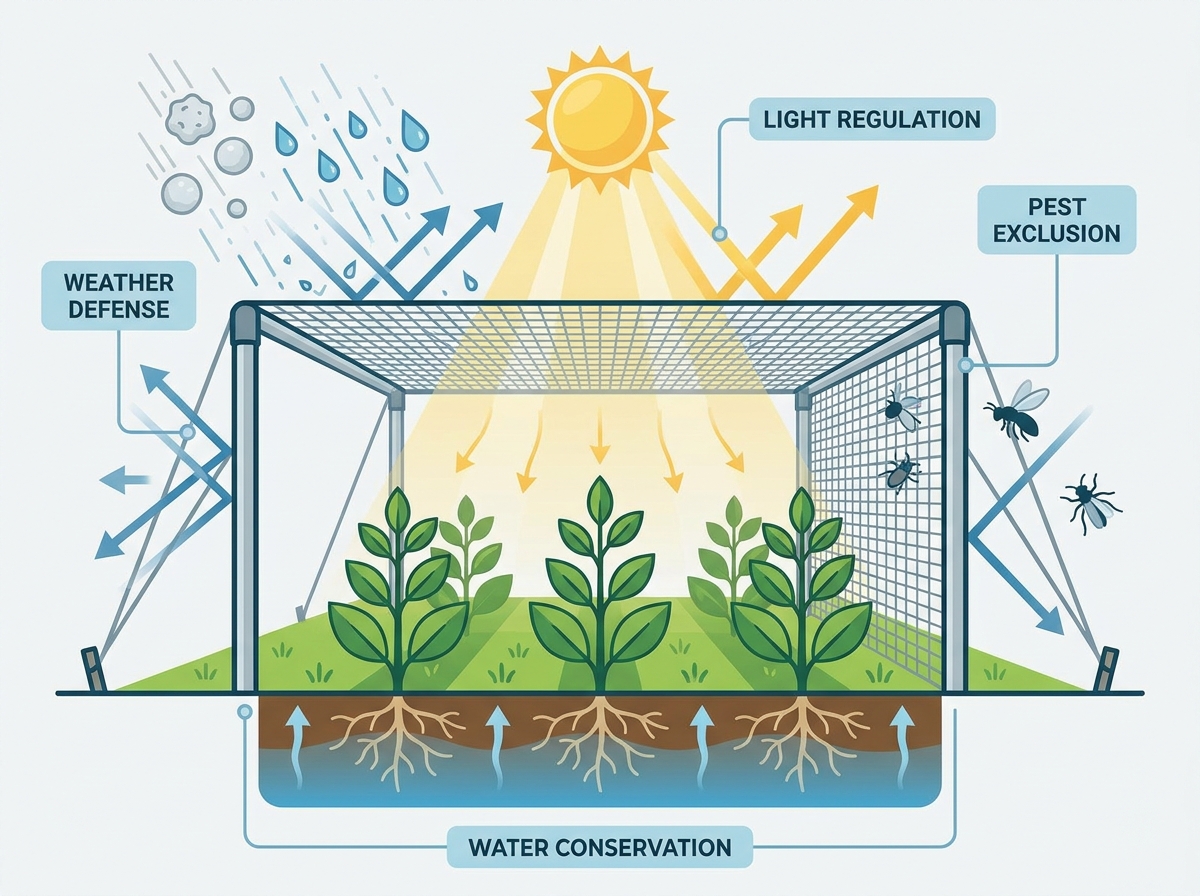
Thermal & Light Control: Shade cloth regulates Photosynthetically Active Radiation (PAR) and temperature, mitigating heat stress without stunting growth.
Weather Defense: Nets act as structural barriers against hail, heavy rain, and excessive wind shear.
Pest Exclusion: Specific mesh geometries reduce reliance on chemical pesticides by physically blocking disease vectors.
Water Conservation: Lowering ambient temperatures reduces soil evaporation and plant transpiration, directly decreasing irrigation costs.
Procurement Logic: Selecting the right net requires balancing crop-specific shading percentages (e.g., 30% vs. 70%), material durability (UV-stabilized HDPE), and structural wind-load capacities.
Role 1: Microclimate Management and Light Regulation
The primary mechanism of any shading system involves modulating direct sunlight. You must prevent leaf burn and heat stress during peak summer months. However, plants still require adequate light to drive photosynthesis. A high-quality Shade Cloth achieves this delicate balance. It diffuses intense solar radiation into manageable energy.
Evaluation Dimension: Features-to-Outcomes
Shading percentages dictate the total volume of light penetrating the canopy. You cannot guess this number. Light-tolerant crops require lower shading factors. Peppers and tomatoes typically thrive under 30% to 40% shade coverage. Shade-loving plants demand heavier protection. Ferns and orchids often need 70% to 80% coverage to avoid scorching.
Color variations also play a massive role in light regulation. Different pigments filter specific light spectrums.
Black: This color absorbs maximum heat and provides dense shade. It is highly durable but can warm the air slightly directly underneath.
White or Aluminized: These options reflect solar energy. They provide excellent light diffusion and actively cool the underlying microclimate.
Green: Growers use green for standard agricultural applications. It blends with the environment and blocks specific excessive light bands.
Evidence-Oriented Claims on Shading
Properly specified shading prevents photoinhibition. Photoinhibition occurs when plants receive more light energy than they can process. This excess energy damages their photosynthetic structures. Conversely, over-shading will reliably cause etiolation. Etiolation forces plants to develop weak, elongated stems as they stretch for light.
Baseline climate data must dictate your shading rate. Review historical peak temperatures and local solar radiation levels. You must match these metrics to your specific crop requirements.
Best Practices for Light Regulation
Always measure the Photosynthetically Active Radiation (PAR) at the canopy level. Take readings both inside and outside the shaded area. Adjust your material choices based on these empirical PAR readings.
Role 2: Physical Defense Against Extreme Weather
Agricultural nets provide a robust structural shield. The primary mechanism involves absorbing kinetic energy from falling hail. They also diffuse heavy rainfall into gentle mists. This diffusion prevents mechanical damage to fragile crop leaves. It also stops severe soil erosion and root exposure.
Evaluation Dimension: Scalability and Durability
You must evaluate material construction when planning weather defense. Manufacturers use two primary methods: knitting and weaving.
Knitted nets utilize an interlocking loop structure. They resist unraveling when a hailstone punctures them. This localized damage stays small. Growers highly prefer knitted structures for hail-prone regions. Woven nets offer much tighter grid structures. They provide excellent heavy shade. However, they may tear linearly if structural damage occurs.
Wind permeability is another critical evaluation metric. A solid, impermeable barrier creates destructive wind loads. An engineered Agro Protection Net filters the wind instead. It allows a safe percentage of air to pass through. This filtration reduces shear stress on delicate plant stalks. It also preserves necessary airflow for disease prevention.
Implementation Risks
Failing to calculate local peak wind speeds is dangerous. You must match these speeds against the net’s permeability rating. If the fabric catches too much wind, the tension increases exponentially. This mistake can lead to the structural collapse of the entire supporting framework.
Common Mistakes in Weather Defense
Many growers install netting too flat. You must introduce a slight pitch or slope to the structure. A flat installation allows heavy rain and hail to pool. Pooling weight will eventually tear the material or snap the cables.
Role 3: Biological Shielding and Pest Exclusion
Pest damage creates massive financial losses globally. Agricultural nets offer an immediate, non-toxic solution. They create a physical barrier against birds, bats, and larger insect pests. This mechanism separates the crop from airborne threats entirely.
Evaluation Dimension: Trade-offs in Mesh Geometry
You must select a mesh size matched to your target pest. Different threats require different exclusionary geometries.
Large Pests: Use a wide grid for birds and bats. This size allows maximum airflow while stopping avian attacks.
Medium Insects: Use a medium weave for moths and butterflies. It prevents caterpillars from establishing colonies on your leaves.
Micro Pests: Use highly dense meshes for thrips, aphids, and fruit flies. These exclusionary nets demand precise manufacturing.
You must manage the airflow restriction trade-off. Tighter meshes increase pest protection significantly. However, they drastically reduce interior ventilation. Reduced airflow traps moisture inside the crop canopy. High internal humidity directly increases fungal disease risks. You might stop the insects but encourage mildew.
Compliance and Return on Investment Context
Physical exclusion heavily reduces your reliance on chemical sprays. Fewer applications lower your recurring consumable costs. This strategy also supports strict organic certification compliance. Retailers pay premium prices for pesticide-free produce. A durable Agro Protection Net transforms pest management from a chemical problem into a structural solution.
Role 4: Resource Optimization and Moisture Conservation
Water scarcity forces modern farms to rethink irrigation. Shade systems act as powerful water conservation tools. They reduce ambient temperatures and block drying winds at the soil level. These two factors directly lower evapotranspiration rates.
Evaluation Dimension: Economic Impact
Lower evapotranspiration drives massive irrigation efficiency. Your soil retains moisture for much longer periods. Reduced water loss translates directly to lower pumping costs. You achieve better water utilization in drought-prone regions. Heavily regulated water districts often mandate such conservation measures.
Moisture conservation also protects overall soil health. Rapid drying causes severe surface crusting. Crusted soil repels future irrigation and harms beneficial microbes. Shading prevents this rapid evaporation. It maintains a soft, porous soil structure necessary for aggressive root development.
Transparent Assumptions on Water Savings
Return on investment models for water savings rely on one major assumption. You must adjust your optimal irrigation scheduling after installation. Many growers leave their automated timers on previous settings. Static watering schedules will completely negate these savings. You will simply overwater your crops if you ignore the new microclimate data.
Best Practices for Resource Optimization
Install soil moisture sensors at multiple depths. Monitor the drying curves before and after erecting the netting. Recalibrate your drip irrigation controllers based strictly on the new sensor data.
Shortlisting Logic: How to Evaluate an Agro Protection Net Supplier
Not all agricultural plastics perform equally. You must evaluate suppliers based on hard material science. Treat this purchase as a long-term capital asset, not a seasonal consumable.
Material Science Focus
Always look for High-Density Polyethylene (HDPE). Do not accept standard Polyethylene (PE) for commercial applications. HDPE offers vastly superior tensile strength. It also demonstrates high resistance to common agricultural chemicals and sulfur-based sprays.
Polymer Comparison Chart
Material Feature | Standard Polyethylene (PE) | High-Density Polyethylene (HDPE) |
|---|---|---|
Tensile Strength | Low to Moderate | Extremely High |
Chemical Resistance | Degrades quickly | Highly resistant to sprays |
Puncture Resistance | Tears easily under stress | Absorbs heavy blunt impacts |
Thermal Stability | Warping occurs in high heat | Maintains structural integrity |
UV Stabilization Requirements
Raw plastics cannot survive constant solar exposure. Un-stabilized polymers degrade within a single season. Commercial UV radiation causes the material to turn brittle and shatter. You must demand verification of UV-resistant additives. Ask the manufacturer for their compounding specifications. Target a 5 to 8 year functional lifespan for any permanent installation.
Manufacturing Tolerances and Edging
You must assess the uniformity of the mesh structure. Look for consistent hole sizes across the entire roll. More importantly, inspect the quality of the reinforced edges. We call these reinforced borders the selvage. Weak edges are the primary point of failure. When contractors apply tension during installation, weak selvages rip instantly.
Implementation Realities & Rollout Lessons
Procuring excellent material is only the first step. Flawed execution will destroy high-quality netting. You must plan the rollout phase with architectural precision.
Structural Anchoring
A premium Shade Cloth is only as strong as its supporting infrastructure. Wooden poles must be treated against rot. Steel cables must carry high tension ratings. Tensioning procedures must account for material expansion and contraction. HDPE expands during hot afternoons and contracts during freezing nights. Rigid mounting systems will tear the contracting fabric.
Timing of Deployment
Installing nets over mature crops is extremely risky. Tractors, ladders, and falling tools cause mechanical damage to the plants below. Rollout systems should be integrated during initial field preparation. Alternatively, complete the installation during dormant winter seasons. Give your team an empty field to work safely.
Maintenance Requirements
No agricultural system is truly maintenance-free. You must schedule periodic inspections.
Check for localized tearing after every major storm.
Inspect anchor points for shifting or loose hardware.
Perform tension adjustments to prevent wind whip.
Wind whip occurs when loose fabric flaps violently in the breeze. This continuous snapping accelerates material fatigue. It destroys the UV stabilizers and shreds the netting fibers prematurely.
Conclusion
An Agro Protection Net is never just a generic commodity. It represents a vital agricultural asset that actively controls light. It stops catastrophic weather damage before it strikes. It limits airborne pests and saves millions of gallons of water. By understanding these four roles, you can optimize your entire farming operation.
Moving from evaluation to procurement requires distinct action. First, audit your specific crop requirements against local climate data. Next, map your worst-case wind and hail scenarios. Finally, contact specialized manufacturers directly. Request physical material samples and technical specification sheets. Always demand project-specific tensioning guidelines to ensure a flawless installation.
FAQ
Q: What is the typical lifespan of a commercial-grade shade cloth?
A: A commercial-grade net typically lasts 5 to 8 years. This lifespan depends heavily on the UV stabilization quality used during manufacturing. Local solar radiation intensity also affects durability. Proper tensioning during installation prevents wind whip, which is crucial for maximizing the functional life of the material.
Q: How do I choose the correct shading percentage for my farm?
A: It requires cross-referencing your specific crop type with environmental data. You must classify your plants as light-loving or shade-tolerant. Then, review your local peak summer temperatures and solar radiation levels. Match the shading percentage to ensure adequate light transmission while preventing excessive heat stress.
Q: Can an agro protection net replace a greenhouse?
A: No. Shade nets actively manage microclimates and protect against physical damage like hail. However, they do not trap heat for winter growing. They also cannot offer the full environmental isolation that a sealed greenhouse provides. They are meant for open-field enhancement, not total climate control.


