

Standard, untreated garden covers often fail within a single planting season. UV degradation breaks down basic plastics rapidly. High wind shear tears flimsy materials apart. Incorrect mesh sizing leaves crops fully exposed. You face severe operational costs from these constant failures. Growers suffer immediate crop loss from sudden pest incursions. Poorly designed covers restrict essential airflow. This stagnation inevitably leads to devastating fungal outbreaks. You also waste budgets on continuous replacement covers. To prevent this, you need a strictly criteria-based evaluation framework. We built this guide to help you select the exact material for your needs. We cover how to plan your structural integration properly. You will also learn how to choose precise mesh specifications. These details help you stop specific environmental threats effectively.
Key Takeaways
Mesh size must be mapped strictly to the smallest target threat (e.g., 0.25mm for thrips, 15mm for birds) while accounting for airflow reduction.
Material composition dictates ROI: High-Density Polyethylene (HDPE) with UV stabilization is the baseline requirement for multi-season commercial use.
Implementation dictates efficacy: A high-spec agro protection net will fail if edge-securing and structural tensioning (hoops vs. direct drape) are not properly executed.
Netting requires a trade-off assessment regarding light transmission, thermal retention, and pollinator access during flowering stages.
Defining the Primary Threat: Matching Vulnerabilities to Net Capabilities
Avian and Mammal Threats (Physical Exclusion)
Birds and small mammals present a significant physical challenge. They actively try to breach your barriers. You must focus on high tensile strength to resist aggressive pecking. Mammals will scratch and tear at weak spots. You need extruded or heavy-knitted meshes to stop them. These materials absorb focused impacts without fraying. However, you must observe a critical caveat. You must suspend these barriers entirely off the crop canopy. If they rest directly on your plants, birds simply land on them. They will peck right through the gaps to reach the fruit. You avoid this by using rigid structural supports.
Micro and Macro Pests (Biological Exclusion)
Insect pressure requires a completely different approach. You must focus on specific aperture sizes targeting regional pests. You face different threats depending on your location. Cabbage White butterflies require a standard 4mm barrier. Carrot Rust flies demand a tighter 1.3mm aperture. Tiny aphids and thrips require extremely fine woven micro-mesh. They need 0.4mm or even 0.25mm apertures. Woven designs provide this precise sizing. Tighter weaves exponentially increase your risk of overheating. They restrict air movement drastically. They also retain excess humidity around the plant foliage. You must balance pest exclusion against this microclimate shift.
Harsh Weather: Hail, Wind, and Sun Scald
Environmental extremes damage crops faster than pests. Hail crushes delicate stems in minutes. High winds snap branches. Intense sun exposure causes severe fruit scald. You need barriers designed for impact absorption. Monofilament netting works exceptionally well here. Manufacturers design it to modify the localized microclimate. You must choose specific shading coefficients. Typical applications require 10% to 30% shade. This reduces solar radiation effectively. You face one major caveat here. You must install these heavy barriers on true load-bearing structures. Ice and hail accumulate quickly. Their weight will collapse flimsy wire hoops entirely.

Core Specifications to Evaluate in an Agro Protection Net
Material Composition and Longevity
Material composition determines your true return on investment. Standard polypropylene degrades rapidly outdoors. The sun breaks down its molecular bonds in months. You must choose UV-stabilized High-Density Polyethylene instead. We call it HDPE. HDPE resists chemical breakdown from solar radiation. It provides the baseline requirement for multi-season commercial use. Manufacturers rate their products based on expected lifespan. You can typically expect 3 to 7 years of field use. This lifespan depends heavily on your local UV index exposure. A high-quality Agro Protection Net leverages these UV inhibitors to maximize durability.
Mesh Sizing and Geometry
You evaluate covers based on standard aperture metrics. Manufacturers measure these in millimeters. A 0.8mm x 0.8mm grid indicates the exact hole size. You also must choose between two distinct manufacturing geometries. Manufacturers either weave or knit the plastic threads.
Geometry Type | Manufacturing Method | Primary Advantage | Best Use Case |
|---|---|---|---|
Woven | Threads intersect cleanly at right angles | Maintains precise, rigid aperture sizes | Excluding micro-pests and small insects |
Knitted | Threads loop and interlock together | Resists unraveling if cut or torn | Structural weather covers and bird exclusion |
Woven threads stay perfectly straight. They maintain exact hole sizes to block tiny insects. Knitted structures stretch slightly. They absorb kinetic energy well. They will not unravel if a branch tears them.
Weight and Density (GSM)
You measure agricultural fabrics in Grams per Square Meter. We abbreviate this as GSM. GSM acts as a primary indicator of durability. It also indicates thermal insulation capacity. A lightweight 30 GSM fabric allows excellent air exchange. A heavy 120 GSM fabric traps significant heat. You must consider the impact of heavy GSM on delicate seedlings. You cannot drape dense fabrics directly over young plants. The sheer weight will crush weak stems. Heavy rain compounds this problem. Water sits on dense weaves and multiplies the weight. You must use structural support for high GSM materials.
Evaluating the Operational Trade-offs: Airflow, Light, and Pollinators
The Ventilation Compromise
Every barrier reduces natural ventilation. Sub-1mm insect barriers impact localized wind speed heavily. They can drop internal air velocities by up to 70%. This reduction lowers plant transpiration rates significantly. Stagnant air allows moisture to pool on leaf surfaces. Fungal risks multiply rapidly under tight meshes. Powdery mildew and Botrytis thrive in these exact conditions. You must deploy mitigation strategies. You should increase your plant spacing. This encourages better internal airflow. You might also need proactive mechanical ventilation in longer tunnel structures.
Light Transmission Reduction
Solid barriers intercept incoming solar radiation. They reduce the total Photosynthetic Active Radiation reaching your plants. We call this PAR. You must calculate the exact shading effect. Color plays a massive role here. Black materials absorb heat. They create heavy, distinct shade lines. White materials scatter incoming light. They create diffuse light underneath. Plants often prefer diffuse light. It penetrates deeper into the lower canopy. Even transparent plastics block 10% to 15% of available light. You must factor this reduction into your yield projections.
Managing Pollinator Access
You install covers to exclude bad insects. Unfortunately, they also exclude essential pollinators. Bees cannot penetrate these barriers. This creates a critical issue during flowering stages. Many fruiting crops rely entirely on insect pollination. You need clear strategies to manage this access. You can time your cover removal carefully. You pull it back just before blossoms open. You replace it after fruit set. Some growers utilize introduced pollination instead. They place commercial bumblebee hives directly under the protective tunnels. This keeps pests out while ensuring proper pollination inside.
Implementation Realities: Structural Requirements and Common Failures
Direct Drape vs. Suspended Support Systems
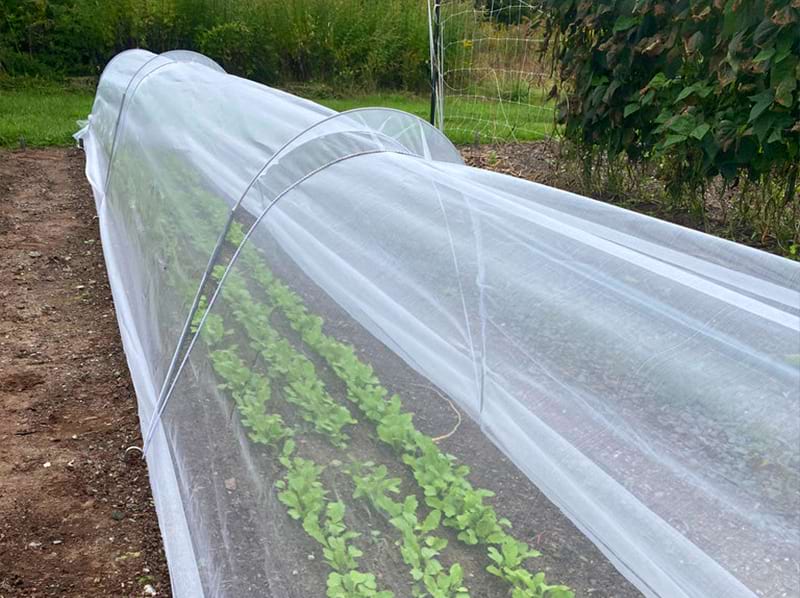
Growers often drape fleece directly onto their crops. They rest the material right on the foliage. This direct draping causes severe physical abrasion. High winds rub the coarse plastic against delicate leaves. This damages the protective plant cuticle. Furthermore, direct contact defeats pest exclusion. Insects land on the exterior surface. They simply lay their oviposition eggs straight through the holes onto the leaves. You avoid this by using suspended support systems. You should build sturdy hoop houses. High tunnels provide excellent clearance. Tensioned cable grids work well for larger orchards.
Securing the Perimeter
Your installation is only as strong as its edges. Unsealed soil borders act as the primary failure point. Ground-dwelling pests crawl right underneath loose edges. High winds lift unsecured plastic easily. Once wind enters underneath, it acts like a parachute. It will rip the entire assembly from the ground. You must seal the perimeter completely. Consider these practical methods:
Trenching: You dig a shallow ditch, place the edge inside, and backfill it with heavy soil.
Sandbags: You lay heavy, UV-resistant sandbags end-to-end along the entire border.
Landscape Pins: You drive long steel staples through the reinforced edges deeply into firm soil.
Access and Workflow
Semi-permanent structures change your daily workflow. You must factor in routine operational delays. Harvesting takes longer when you must navigate barriers. Weeding times increase significantly. Daily crop inspection requires you to open and reseal the edges. You must plan for efficient human access. You can install industrial zippers at the ends of tunnels. You might use Velcro closure systems for smaller beds. Do not overlook these labor costs. A difficult system frustrates workers. They might leave edges unsealed to save time. This negates your entire investment.
Shortlisting Your Agro Protection Net: A Buyer’s Checklist
You must formalize your purchasing decision. Use this strict criteria-based checklist. It ensures you evaluate the right technical metrics before ordering.
Step 1: Identify the smallest pest or primary weather threat to dictate the maximum allowable mesh size. You map this threat first to set the baseline aperture.
Step 2: Calculate your total coverage area accurately. You must add a 15% to 20% buffer. This extra material accounts for structural tensioning, edge securing, and eventual plant vertical growth.
Step 3: Verify manufacturer specifications strictly. Check their UV stabilization warranties. Evaluate the specific tear-resistance properties of their knitted versus woven options.
Step 4: Assess your current farm infrastructure objectively. Ask yourself a critical question. Can your current hoops bear the wet weight of the newly selected cover?
Conclusion
Selecting the correct protective barrier requires a strict evaluation process. You must prioritize accurate threat mapping above all else. You acknowledge the inevitable environmental trade-offs regarding light and airflow. You must invest primarily in high-quality, UV-stabilized materials to ensure a positive operational return. Avoid cheap plastics. They fail quickly and cost more in labor.
We highly recommend beginning with a small test plot. You should deploy tighter insect meshes on a limited scale first. This allows you to monitor localized humidity spikes. You can track temperature shifts accurately. You adjust your structural supports based on these findings. Once you confirm success, you proceed with a confident, farm-wide rollout.
FAQ
Q: Can an agro protection net replace the need for chemical pesticides entirely?
A: They are highly effective for physical exclusion. However, they cannot replace chemicals entirely in all situations. You must maintain strict field sanitation. If you accidentally trap pests inside during installation, they will multiply rapidly. There are no natural predators inside the enclosure. You must scout vigilantly.
Q: What is the difference between frost fleece and insect mesh?
A: Frost fleece is a spun-bound, non-woven fabric. It traps heat efficiently but offers very low breathability. Growers use it strictly for temporary thermal retention in winter. Insect mesh features an open, woven grid. It provides high breathability for summer use but retains almost no heat.
Q: How do you clean and store agricultural netting to maximize its lifespan?
A: You must remove all organic debris before storage. Wash it gently with a low-pressure hose. Allow it to dry completely to prevent fungal rot. Fold it carefully. Store it inside sealed plastic totes or metal bins. Mice and rats will nest in unprotected bundles over winter.
Q: Will 0.6mm insect netting stop aphids and thrips?
A: A 0.6mm aperture blocks many medium-sized insects effectively. However, it will not stop thrips. Thrips require a much tighter 0.25mm to 0.35mm mesh. A 0.6mm gap might slow down adult aphids, but nymphs can still squeeze through. Always match the hole size to the youngest pest stage.