

You have a real choice to make when your crop depends on day length. A light deprivation greenhouse uses blackout curtains and a timed system to control light exposure. A standard greenhouse relies on natural day length unless screens or lighting change it. That one difference drives the differences between light deprivation greenhouse and standard greenhouse in climate load, crop fit, cost, and control setup. Photoperiod control is the deciding factor for many growers. Match the structure to your photoperiod goals, your climate, and your budget. Plan your curtain schedule and utility capacity before you commit. Both designs work well when you specify them for the right job.
Key Takeaways
A light deprivation greenhouse uses blackout curtains and timers to control the light cycle. A standard greenhouse depends on the natural length of the day.
Light deprivation greenhouses need stronger airflow and moisture removal. Standard greenhouses use natural sunlight for heat and fresh air from vents.
Pick light deprivation for short-day or long-day crops that need a set photoperiod. Pick standard for seasonal production and general horticulture.
Light deprivation costs more to set up and run. But growing more crops each year can make up for the higher costs.
Figure out your light schedule goals and power needs before you build. Check your local light-control rules early.
Key Differences at a Glance
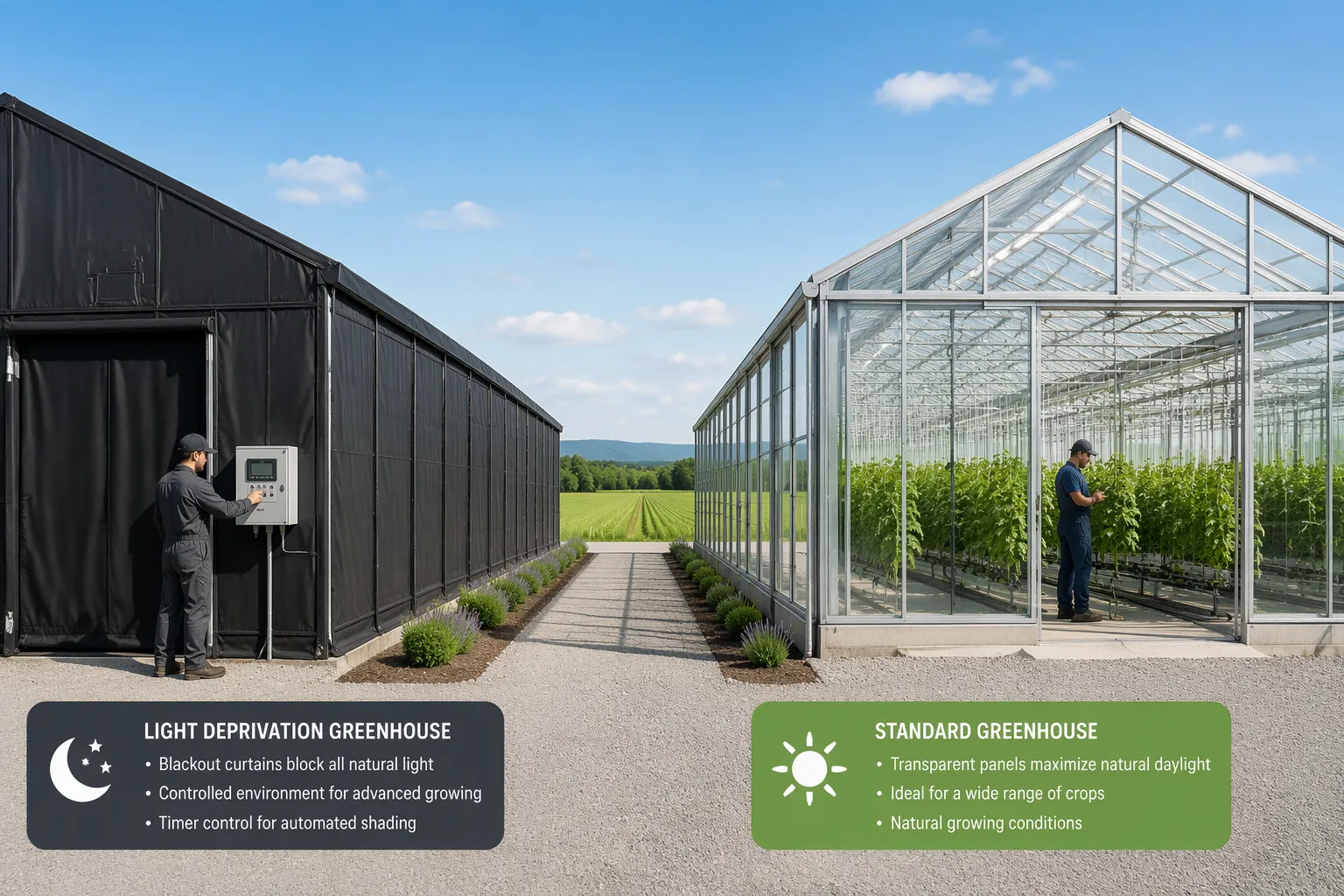
A light deprivation greenhouse uses opaque curtain systems and timed controls to manage photoperiods. A standard greenhouse relies on natural day length unless you add supplemental lighting, shade systems, or other controls. That is the core answer to the light deprivation greenhouse vs. standard greenhouse question. The differences between light deprivation greenhouse and standard greenhouse then flow into climate load, crop fit, cost, and compliance.
Comparison Table
Factor | Light Deprivation Greenhouse | Standard Greenhouse |
|---|---|---|
Light control | Blackout curtains plus timers set the light cycle | Natural daylight, unless you add screens or lamps |
Climate and utility load | Curtains trap heat and humidity; ventilation and dehumidification matter more | Passive solar gain does most of the work |
Crop fit | Short-day and long-day crops that need a set crop photoperiod | Seasonal production, propagation, general horticulture |
Upfront and operating cost | Higher equipment cost; more harvests per year can offset it | Lower equipment cost; output follows the season |
Installation complexity | Curtain tracks, motors, and controls need careful setup | Simpler structure and fewer moving parts |
Compliance | Light-leak rules may apply, depending on crop and region | Fewer light-control rules in most cases |
This table is a quick reference. Later sections cover photoperiod control, climate loads, crop suitability, costs, commissioning, and compliance in more detail.
How Each Type Fits
Passive greenhouse shade netting manages solar radiation and heat. It does not give you full photoperiod control on its own. Adjustable blackout systems do. Keep that line clear when you compare options. Agricultural shade netting comes in many specifications, including shading rate, material, size, color, and packaging. Shuorui supplies UV-resistant HDPE shade netting with OEM/ODM customization, including a custom shade rate for your project.
Both designs have real advantages. Your crop photoperiod, climate, production schedule, utility capacity, budget, and local rules decide the better fit. A standard greenhouse suits many operations well. A light deprivation house earns its keep when day length drives your revenue.
Photoperiod Control in a Light Deprivation Greenhouse
Blackout Curtains and Timed Systems
You get real control over the schedule when you pair an opaque curtain with a manual or automated timer. The blackout material blocks light from outside. The timer opens and closes the curtain at set times. Together, they let you copy seasonal changes on a schedule. You decide when the day starts and when it ends.
A dependable blackout system keeps the dark period intact. Any stray light during the dark phase can upset flowering. Check seams, edges, and curtain overlaps before each cycle. Full blackout depends on tight seals, not just heavy fabric. Many builds use two blackout layers to cut light leaks even more.
Extending and Manipulating Cycles
With photoperiod control in place, you can control the dark period to match each crop stage. Short-day crops need a long required stretch of uninterrupted darkness. Long-day crops need the opposite. You set the required dark interval and keep it steady. A repeatable dark period gives you results that are consistent and predictable.
This approach makes year-round growing possible. A light deprivation greenhouse can produce multiple harvests per year, often four to five, compared with a single outdoor grow. Each light deprivation cycle follows your plan, not the calendar.
An exterior blackout greenhouse is often cheaper to build. You do not need as large a greenhouse as you would for retrofitting an interior LD system into a standard house. Plan your photoperiod targets early, then size the curtain and controls to match.
Natural Light in a Standard Greenhouse
Reliance on Day Length
A standard greenhouse uses natural day length as its main light source. You plant and harvest around the seasons. The sun sets the schedule, not a timer. This keeps the structure and operation simpler. You need fewer motors, fewer controls, and less maintenance.
The trade-off is a shorter growing season. Output follows the calendar. You get strong production in the long days of summer and a slower pace in winter. For many operations, that rhythm works well. Seasonal production, propagation, and general horticulture all fit this model. You spend less on equipment and more on the crops themselves.
When Screens or Lighting Are Added
You can add screens or lamps to a standard greenhouse. Shade netting cuts solar radiation and heat. Supplemental lighting extends the working day. These additions improve control, but they change the cost and complexity profile. You now manage new equipment, new settings, and new maintenance tasks.
Full photoperiod control takes more than shade cloth. Passive netting manages light intensity, not the length of the dark period. A true blackout system needs opaque curtains, tight seals, and timed controls. At that point, your standard greenhouse starts to behave like a light deprivation house. That is a valid path. Just budget for the added equipment and plan the controls before you build.
Climate and Utility Loads
Temperature, Humidity, and Ventilation
A closed blackout system changes the heat and moisture balance inside the house. During the dark period, the curtain traps warm air near the crop canopy. Humidity also rises, because the same barrier that blocks light slows air exchange. You need stronger ventilation and dehumidification to keep the crop healthy. Before you install the fabric, plan for fans, vents, and moisture control.
A standard greenhouse works in a different way. Glazing lets passive solar gain warm the space, and natural or mechanical venting carries moisture away. You still manage temperature and humidity, but the load is lighter and easier to predict. The trade-off depends on your climate and crop. A humid coastal site needs more dehumidification in either design. A dry, sunny site depends more on shading and venting.
Energy Demand Compared
Energy demand follows the same logic. A light deprivation greenhouse, a standard greenhouse, and an indoor farm each have a different utility profile. The LD house can greatly cut energy consumption and total cost compared with other controlled growing methods. You run fans, motors, and dehumidifiers on a set schedule, and you avoid the heavy lighting loads of a fully indoor operation.
A standard greenhouse with the right climate systems relies on passive solar gain for most of its heat. That keeps energy use low in mild seasons. A standard greenhouse still needs active climate systems in extreme heat or cold. Neither design wins everywhere. Your climate zone, crop, and schedule decide which load profile fits your operation and your utility budget.
Crop Suitability and Operational Modes
Crops Suited to Light Deprivation
You get the most from a light deprivation greenhouse when day length sets your harvest date. Short-day crops react to long, unbroken dark periods. A short-day response starts flowering once the night reaches a set length. Long-day crops work the opposite way. They flower when the dark period stays short. In both cases, you set the required photoperiod and keep it steady.
High-value specialty crops also benefit from this level of control. You can time a crop-specific photoperiod to hit a market window, stagger plantings, and run several cycles each year. The schedule serves your sales plan, not the season. Growers who need predictable growth and flowering cycles on a calendar find this control valuable.
Crops Suited to Standard Greenhouses
A standard greenhouse fits seasonal production well. You plant with the natural day length and harvest when the crop finishes. Spring bedding plants, summer vegetables, and fall crops all follow this rhythm. The structure stays simple, and the sun does most of the light work.
Propagation and general horticulture also suit this design. Seedlings, cuttings, and young transplants need steady warmth and light, not a strict dark period. A standard greenhouse delivers that at lower equipment cost. You can add shade netting to soften summer radiation and protect tender starts. Many operations run both designs side by side. The light deprivation house handles photoperiod-sensitive crops, and the standard house covers everything else.
Cost and Yield Considerations
Installation and Equipment Costs
A light deprivation build costs more at the start. You pay for blackout fabric, curtain tracks, motors, and a timer or control panel. Each part needs to be installed correctly. A standard greenhouse skips most of that hardware. You buy the frame, glazing, and basic ventilation, and the sun does the rest. That simpler structure keeps the first bill lower.
The gap grows with the control level. A manual curtain costs less than an automated one. Full automation adds sensors and climate integration, and those items raise the price again. Decide how much control your crop really needs. A basic timed system often covers a photoperiod plan without the full automation package.
Operating Costs and Yield Trade-offs
Running costs follow the equipment. A light deprivation house runs fans, motors, and dehumidifiers on a schedule. A standard greenhouse leans on passive solar gain and natural venting, so its utility bill stays lower in mild seasons. You trade higher running costs for tighter control over the light cycle.
That control can pay you back. A light deprivation greenhouse can deliver multiple harvests per year, often four to five, compared with a single outdoor grow. More cycles per year can offset the added equipment and energy cost. The math depends on your crop price, your market window, and your climate.
Fabric choice affects cost in either build. Shuorui supplies shade cloth and blackout-capable fabrics with OEM/ODM customization. You can specify shade rate, size, and packaging to match your project. That flexibility lets you budget the fabric to the job, whether you run a full blackout house or a simpler structure.
System Interfaces and Commissioning
Controls and Automation
A light deprivation house works best when its curtain system connects to the rest of the climate equipment. Modern controllers link the curtain motor to temperature sensors, humidity probes, and ventilation relays. You set a photoperiod schedule, and the controller runs the curtain on time while it checks the indoor climate. If heat builds during a closed period, the system can adjust fans or vents without breaking the dark cycle.
This connection matters most in fully-automated light deprivation systems. One panel can run the curtain, the fans, and the dehumidifiers together. You avoid conflicts between separate timers. Manual or fully automated light deprivation greenhouses both gain from clear wiring diagrams and labeled control points. Keep a simple logic map on site. Your operator should know which sensor causes which action.
Startup and Commissioning
Commissioning proves the system holds a true dark period. Go through these steps before you plant:
Run the curtain through its full travel several times. Check the track, the tension, and the end stops.
Program the timer for your target cycle. Make sure each open and close event fires at the right time.
Inspect for light leaks at seams, edges, and door frames. Walk the house during a closed cycle and look for bright spots.
A blackout system only gives uninterrupted darkness when the seals stay tight. Repeat the leak check after the first few cycles. Small gaps often appear once the fabric settles.
A standard greenhouse needs much less commissioning. You check vents, fans, and basic controls, and then you are ready to grow. The opaque curtain hardware and its timing logic are what add the extra startup work in an LD build.
Compliance and RFQ Inputs
Light-Control Compliance Factors
Light-control rules change by area and by crop. Some places limit light from greenhouses during dark hours. Others link blackout rules to the crop you grow. A few programs ask for records that prove your dark period holds. Confirm local rules before you finalize the design. Check with your local farm authority and your crop buyers early. Their answers shape your curtain spec and your control level.
Light leaks matter for more than compliance. A loose seal can break the dark cycle and upset flowering. Check seams, edges, and door frames during a closed cycle. Fix gaps before you plant. Write down your inspection routine, too. A simple log of cycle times and leak checks helps any compliance review and protects your crop schedule.
What to Include in an RFQ
A clear request for quote saves weeks of back-and-forth. Include these items:
Greenhouse size, including height and bay layout
Crop type and your photoperiod goals
Curtain type and the control level you need
Climate zone and expected weather extremes
Utility capacity for fans, motors, and dehumidifiers
Add your installation timeline and any local compliance notes. Suppliers who offer OEM/ODM customization can tailor shade rate, size, and packaging to the project. That flexibility helps you match the fabric to your climate and your budget. Send the checklist with your drawings, and ask each supplier to confirm the specs in writing.
The differences between light deprivation greenhouse and standard greenhouse designs really come down to control. A light deprivation greenhouse adds photoperiod control by using blackout curtains and timers. That control makes equipment and operating costs go up. A standard greenhouse gives you simplicity and natural light at a lower cost. Neither option is best in every case. Match the design to your crop, climate, operational goals, and budget. The differences between light deprivation greenhouse and standard greenhouse setups matter most when you plan ahead. Use the comparison table to weigh each factor. Then build your quote request with the checklist. A clear photoperiod target and a realistic curtain budget will lead you to the right greenhouse.
FAQ
Can you turn a standard greenhouse into a light deprivation house?
Yes, you can. You add blackout curtains, tracks, motors, and a timer to the frame you already have. This often costs more than building a new blackout house outside. Before you start, check that your structure is tall enough and strong enough to hold the extra weight.
Does shade netting control the light cycle?
No. Shade netting lowers light strength and heat. It does not create a full dark period. Real photoperiod control needs blackout fabric that blocks light, tight seals, and timed operation. Think of netting and blackout systems as different tools for different jobs.
How many harvests can a light deprivation greenhouse give you each year?
A well-run light deprivation house can produce several harvests per year, often four to five, compared with one outdoor grow. Your crop, climate, and cycle length set the real number. Plan each cycle around the time you want to sell.
What causes light leaks, and why do they matter?
Most leaks come from gaps at seams, edges, and door frames. A leak can break the dark cycle and upset flowering. Walk through the house during a closed cycle and look for bright spots. Check again after the fabric settles.
What should you confirm before you order a blackout system?
Confirm the local light-control rules for your crop and area. Then collect your greenhouse size, photoperiod goals, curtain type, control level, climate zone, and utility capacity. Send these with your drawings and ask each supplier to confirm the specs in writing.


