

Deploying heavy-duty shade cloth requires significant capital and labor. Premature material failure introduces hidden replacement burdens that disrupt operations. Facility managers and agricultural operators need reliable infrastructure, yet the industry presents massive discrepancies in lifespan estimates. Some manufacturers claim five years of utility, while others report twenty-five years of continuous use. These vague claims complicate procurement decisions and long-term site planning.
You need a realistic evaluation framework. Durability depends heavily on material composition, environmental stressors, structural installation, and maintenance protocols. Understanding how polymers degrade under solar radiation changes how you select materials. Recognizing mechanical stress points alters how you build support frames. This guide breaks down the exact factors determining operational longevity. You will learn how to maximize the functional life of your shade structures through strategic material selection and precise installation techniques.
Key Takeaways
Baseline Lifespan: High-quality, properly installed shade cloth typically yields 8–12 years of continuous use, extending up to 15–20+ years with seasonal removal and optimal storage.
Material Superiority: High-Density Polyethylene (HDPE) combined with integrated UV stabilizers is the industry standard for resisting photodegradation and thermal breakdown.
Mechanical Stress is the Primary Threat: Wind whip, improper tensioning, and friction cause more premature failures than UV exposure alone.
Construction Matters: Knitted structures inherently resist tearing and fraying better than woven alternatives, making them critical for high-wind or commercial environments.
Baseline Expectations: How Long Should Shade Materials Actually Last?
Manufacturer Ratings vs. Real-World Application
Major manufacturers often rate their products conservatively. A standard rating might promise five to eight years of full sun exposure. They do this to limit warranty liability because they cannot control how you install the material or your local wind conditions. However, real-world agricultural and commercial users frequently report much longer utility. Many operators see ten to twenty-five years of functional use from high-quality netting.
Industry benchmarks show a distinct difference between cosmetic aging and structural failure. Black greenhouse netting often remains structurally sound for over two decades. The color may fade slightly, and dust may settle into the weave, yet the material still provides the required shade percentage. You must define end of life accurately. End of life means severe tensile strength loss. It means the polymer becomes brittle and shatters under light pressure. It means the UV stabilizers have completely depleted. Cosmetic fading does not mean the material has failed.
Field observations consistently prove that physical degradation happens long before optical degradation. A net might look perfectly fine from a distance but tear easily when pulled. Testing the fabric manually by applying localized pressure helps determine its actual structural integrity. If the yarns snap rather than stretch, the polymer chains have broken down, signaling true end of life.
Seasonal Deployment vs. 365-Day Exposure
Leaving materials up year-round accelerates the degradation curve. Winter weather introduces unique threats. Ice accumulation weighs down the fabric, stretching the yarns beyond their elastic recovery point. Freezing temperatures contract the polymer chains, making them temporarily brittle and susceptible to wind damage. Dormant seasons expose the material to solar radiation when shade is not actually needed. This constant exposure steadily consumes the integrated UV stabilizers.
Removing the material during the off-season changes the math. Seasonal deployment often doubles the functional life of the fabric. A net rated for eight years of continuous exposure might last sixteen years if stored properly for six months a year. You multiply the lifespan by reducing the total hours of solar radiation and mechanical stress. The labor required for seasonal removal pays off by delaying major replacement cycles.
Deployment Strategy | Average Expected Lifespan | Primary Wear Factors |
|---|---|---|
365-Day Continuous Exposure | 8–12 Years | Year-round UV load, winter ice accumulation, continuous wind fatigue |
Seasonal (6 Months Active) | 15–20+ Years | Summer UV load, handling stress during installation/removal |
Temporary Event Usage | 20+ Years | Storage degradation, hardware attachment wear |
Material Science: Evaluating Shade Fabrics for Durability
High-Density Polyethylene Properties
Modern shade structures rely on specific polymer chemistry. HDPE shade netting dominates the industry for good reason. High-Density Polyethylene features tightly packed polymer chains. This molecular structure makes it inherently rot-proof. It resists mildew and fungal growth even in high-humidity environments. HDPE remains structurally stable across extreme temperature fluctuations. It does not melt in peak summer heat, and it resists shattering during sudden cold snaps.
Inferior materials fail quickly outdoors. Standard nylon absorbs moisture and degrades rapidly under UV light. Untreated PVC becomes brittle and cracks within a few seasons. HDPE provides the necessary tensile strength while maintaining flexibility. This flexibility allows the fabric to absorb wind loads without snapping the individual yarns. When evaluating materials for a new site, always verify the base polymer. Blended plastics or recycled resins often contain impurities that create weak points in the extruded yarn, leading to premature failure.
The Role of UV Additives and Color
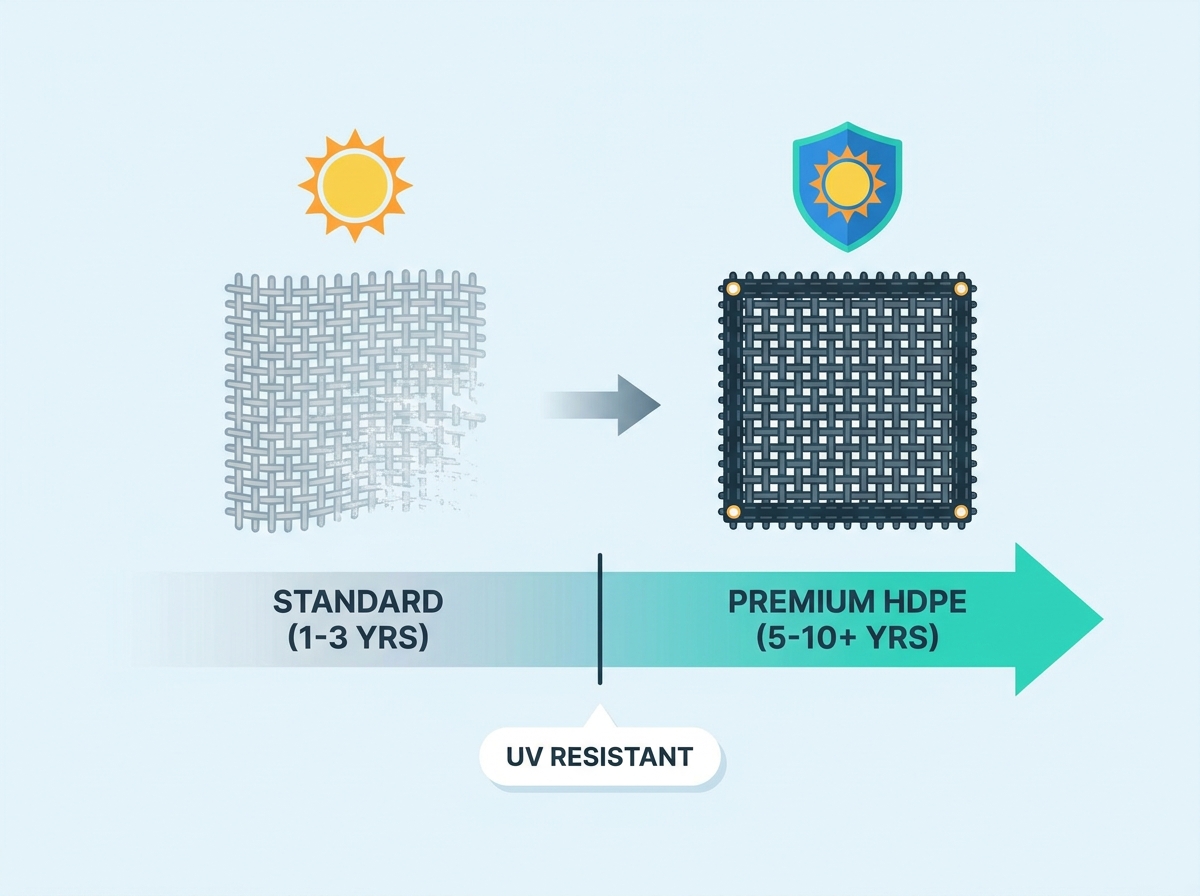
Sunlight destroys unprotected plastics. Prolonged solar radiation breaks the chemical bonds in the polymer through a process called photodegradation. To combat this, manufacturers create UV resistant shade cloth by adding specific chemical stabilizers. Hindered Amine Light Stabilizers (HALS) are the most effective. Manufacturers extrude these stabilizers directly into the polymer yarn during production. They do not just coat the surface. Surface coatings wash off after a few heavy rainstorms. Integrated stabilizers protect the yarn throughout its entire cross-section.
Color significantly impacts longevity. Black netting consistently outlasts lighter colors. This happens because black fabric contains carbon black, a highly effective natural UV absorber. It captures solar radiation and dissipates it as harmless heat. White or aluminized fabrics reflect light well, but their polymer base degrades faster without the protective qualities of carbon black. If maximum lifespan is your primary goal, black is the optimal choice.
Knitted vs. Woven Construction
The manufacturing technique determines how the fabric handles physical stress. Woven cloth consists of straight yarns crossing over and under each other. It feels stiffer and blocks sunlight uniformly. However, woven cloth unravels easily if punctured. A small tear quickly becomes a massive hole under wind tension. Woven materials also lack the elasticity needed to absorb sudden dynamic loads, making them prone to bursting at the attachment points.
Knitted cloth uses a lock-stitch construction. The yarns loop around each other. This design inherently resists tearing. If a branch punctures a knitted net, the hole will not run or unravel. You can execute localized repairs without compromising the entire structure. Knitted construction also stretches slightly, allowing it to absorb sudden wind gusts better than rigid woven fabrics. This elasticity makes knitted fabrics the standard for large-scale outdoor deployments.
Feature | Knitted Construction | Woven Construction |
|---|---|---|
Tear Resistance | Excellent (Lock-stitch prevents unraveling) | Poor (Prone to running if cut) |
Flexibility | High (Absorbs wind loads well) | Low (Rigid and stiff) |
Weight Distribution | Evenly spreads tension across loops | Concentrates tension on straight yarns |
Water Permeability | High (Allows rain to pass through easily) | Low (Can pool water if not angled) |
Best Application | High-wind areas, commercial structures | Pet enclosures, privacy screens |
Environmental Factors Accelerating Degradation
UV Index and Solar Radiation Load
Geographic location dictates the lifespan of your materials. High-altitude environments experience a thinner atmosphere, allowing more intense ultraviolet radiation to reach the surface. Equatorial regions face direct, punishing solar loads year-round. These high UV index zones accelerate the breakdown of chemical stabilizers. A net that lasts fifteen years in a northern, temperate climate might only last seven years in a high-desert or equatorial installation. You must factor your local solar radiation load into your replacement schedules.
Site orientation also plays a role. South-facing slopes receive significantly more direct sunlight than flat terrain or north-facing installations. The angle of incidence determines how much radiation the polymer actually absorbs versus reflects. Adjusting your lifespan expectations based on the specific topography of your site prevents unexpected failures mid-season.
Wind Whip and Mechanical Stress
Wind destroys more shade structures than sunlight. Wind whip acts as the primary catalyst for physical failure. When fabric flaps loosely against a frame, it creates severe mechanical stress. The continuous flexing weakens the polymer chains through material fatigue. The abrasion against metal or wood supports literally sands the material down until it snaps.
Static tension preserves the fabric. Dynamic flapping destroys it. Securing the material tightly prevents this destructive friction. You must design your support structures to minimize unsupported spans. Large expanses of fabric act like sails, catching wind and transferring massive dynamic loads to the perimeter hardware. Breaking up large areas with intermediate support cables reduces the amplitude of the wind whip, preserving the structural integrity of the netting.
Chemical Exposure Risks
Environmental chemistry plays a hidden role in material degradation. Agricultural chemicals and industrial pollutants react with polymer stabilizers, neutralizing their protective properties. You must monitor the environment around your installation to prevent accelerated breakdown.
Pesticides and Herbicides: Direct overspray coats the yarns, and the active ingredients can degrade the HALS additives.
Sulfur Vaporizers: Commonly used in greenhouses for mildew control, sulfur is highly reactive and rapidly destroys UV stabilizers in polyethylene.
Chlorine and Halogens: Proximity to commercial swimming pools or water treatment facilities exposes the fabric to airborne halogens that cause premature brittleness.
Industrial Exhaust: Heavy particulate matter and acidic exhaust from nearby highways or factories settle on the fabric, creating a corrosive layer that eats away at the polymer.
Commercial vs. Agricultural Use Cases
Outdoor Commercial Requirements
Permanent structures demand specific material grades. When evaluating outdoor commercial shade cloth, you must look at the grams per square meter (GSM). Parking lots, playground covers, and event spaces require heavy-weight fabrics, typically exceeding 340 GSM. These applications need architectural-grade tensioning. The fabric must stretch tight like a drum to shed water and resist wind uplift.
High-GSM materials provide the necessary density to withstand this extreme tension without warping. Commercial sites also require strict adherence to local fire retardant codes. Manufacturers add specialized flame-retardant chemicals to the polymer mix for commercial grades. These additives alter the chemical makeup of the yarn, sometimes requiring additional UV stabilizers to compensate for the altered polymer matrix.
Greenhouse and High-Tunnel Applications
Agricultural deployment focuses on crop health rather than architectural aesthetics. Greenhouses need specific light diffusion properties. The netting must scatter light to prevent hot spots on the plant canopy, ensuring uniform photosynthesis. Thermal retention during cool nights is also a factor, with some specialized aluminized screens designed to reflect infrared heat back into the structure.
Agricultural setups frequently integrate automated roll-up systems. The fabric must withstand the daily mechanical wear of rolling and unrolling around metal tubes. Flexibility and lightweight construction take priority over extreme GSM density in these environments. A 150 GSM knitted net provides ample shade and flexibility for a high-tunnel without overloading the automated motors.
Selecting the Right Shade Percentage
The shade percentage directly impacts wind resistance. A 30% shade net features an open weave. Wind passes through it easily, transferring very little load to the support frame. A 70% or 90% shade net features a very tight weave. This denser material catches wind like a sail. Higher percentages require exponentially stronger structural support.
If you install a 90% net on a weak frame, a storm will tear the fabric or collapse the structure entirely. Choose the lowest shade percentage that meets your cooling needs to minimize mechanical wind stress. For example, most vegetable crops thrive under 30% to 50% shade, while human comfort areas require 80% to 95% shade. Match the structural engineering to the density of the fabric.
Installation and Maintenance: Mitigating Premature Failure
Strategic Timing for Installation and Removal
Calendar management extends material life. Deploy the netting in early spring just before peak heat stress begins. Do not install it too early, or you expose it to late-season ice storms. Remove the fabric in late fall before the first frost. Snow loads stretch the polymer beyond its elastic limit, causing permanent deformation. Ice accumulation creates sharp edges that cut the yarns. Strategic timing minimizes exposure to unnecessary environmental hazards.
Proper Tensioning and Structural Support
Achieving optimal tension is a balancing act. Proper tensioning when you hang shade cloth prevents wind whip without over-stressing the fabric. You want the material taut but not stretched to the breaking point. The structural framing must be smooth. Rough wood splinters and sharp metal corners act like knives against the tight fabric. Use PVC piping or padded metal over friction points. Eliminating these abrasion zones prevents localized tearing.
Follow a systematic approach to tensioning:
Secure the primary corners first, applying light manual tension to square the fabric.
Attach the perimeter hardware loosely, working from the corners toward the center of each side.
Engage the turnbuckles or tensioning cables incrementally, moving around the perimeter to ensure even load distribution.
Inspect the fabric for wrinkles or stress lines, adjusting the localized tension to smooth out the surface.
Re-tension the system after the first major weather event, as the polymer will naturally stretch and settle into its final shape.
Hardware Selection and Edge Reinforcement
Attachment points endure the highest stress. Point-loading occurs when wind pulls the entire weight of the fabric against a single fastener. Taped edges with brass or stainless steel grommets distribute this load effectively. The heavy webbing reinforces the perimeter, preventing the grommets from tearing through the knitted loops.
Raw edges attached with snap-on plastic clips work for small, temporary setups. However, raw edges will tear under heavy wind loads. Invest in reinforced perimeters for any structure larger than a backyard garden bed. For large commercial spans, perimeter wire rope threaded through a continuous pocket provides the most robust load distribution, completely eliminating point-loading at individual grommets.
Best Practices for Off-Season Storage
Storage protocols dictate how the material performs next season. Never fold and store dirty netting. Dust accumulation traps moisture. This leads to mold growth on the dirt layer, which can permanently stain and degrade the fabric. Clean the material with low-pressure water and mild soap. Avoid harsh detergents or bleach.
Ensure the fabric is completely dry before folding. Store it in a dark, rodent-proof environment. Mice will chew through folded netting to build nests, ruining large sections instantly. Elevate the stored fabric off the ground on pallets to prevent moisture wicking from concrete floors. Proper off-season care guarantees the material is ready for deployment the following spring.
Conclusion
High-quality shade structures represent a vital operational asset. While eight to twelve years serves as a safe baseline, a fifteen to twenty-five-year lifespan is highly achievable. You reach these upper limits by selecting HDPE knitted materials, applying proper tension, and executing seasonal care. Do not settle for inferior plastics that shatter after three summers. Prioritize UV stabilization ratings, knitted construction, appropriate edge reinforcement, and the correct shade percentage over initial price tags.
Take the following steps to optimize your installation:
Assess your existing structural framing for sharp edges or friction points and pad them with PVC or high-density foam.
Determine the exact shade percentage required for your specific crop or human comfort needs to avoid unnecessary wind resistance.
Measure your footprint accurately to ensure proper tensioning without over-stretching the fabric during installation.
Establish a strict seasonal calendar for deploying and removing the material to avoid snow and ice loads.
Request material samples from suppliers to verify the lock-stitch construction and GSM density before finalizing large orders.
FAQ
Q: Can you leave shade cloth out in the winter?
A: Leaving the material out during winter is not recommended unless it is a permanent commercial structure engineered for snow loads. Snow stretches the fabric beyond its elastic limit. Ice accumulation creates sharp edges that cut the polymer yarns. Winter deployment also subjects the material to unnecessary UV exposure during dormant seasons, depleting the chemical stabilizers faster.
Q: Does the color of the shade cloth affect its lifespan?
A: Yes, color significantly impacts durability. Black fabric generally lasts the longest. It contains carbon black, a highly effective natural UV absorber that dissipates solar radiation as heat. White and aluminized fabrics reflect light well to keep areas cooler, but their polymer base degrades faster because they lack the protective qualities of carbon black.
Q: How do you repair a tear in HDPE shade netting?
A: Because knitted HDPE uses a lock-stitch construction, tears will not run or unravel. You can repair small holes using specialized UV-resistant zip ties or heavy-duty lacing cord. Weave the cord through the intact loops around the tear and pull it closed. For larger damages, apply a UV-resistant patch kit designed specifically for polyethylene fabrics.
Q: What is the standard warranty on outdoor commercial shade cloth?
A: Typical manufacturer warranties range from five to ten years. These warranties specifically cover UV degradation and thermal breakdown. They guarantee the material will not become brittle or shatter from sun exposure. However, warranties almost universally exclude damage caused by wind whip, improper tensioning, mechanical friction, or chemical exposure.
Q: Does a higher shade percentage mean the cloth will last longer?
A: Not necessarily. A higher shade percentage means a denser weave and higher grams per square meter (GSM), which increases tensile strength. However, this dense weave catches significantly more wind. If your structural frame is weak, a 90% shade net will suffer more mechanical stress and fail faster than a 30% net that allows wind to pass through.
Q: Can you wash shade cloth?
A: Yes, regular cleaning extends the material's lifespan. Use low-pressure water and a mild dish soap to remove dust, bird droppings, and chemical residue. Never use high-pressure power washers, bleach, or harsh industrial detergents. These will strip the UV protectants and damage the polymer yarns. Always ensure the fabric is completely dry before storing it.


